
|
Table 1: Key solar energy policies in India |
||||
|
Policy Name |
Year Launched |
Key Features |
Target/Impact |
Reference |
|
Solar Park Scheme |
2014 |
Large-scale solar parks with ready infrastructure |
40,000 MW by 2025-26 |
MNRE (2023) |
|
Viability Gap Funding (VGF) Schemes |
Ongoing |
Financial support up to 40% of project cost |
Catalyze investments in challenging regions |
MNRE (2025) |
|
Central Public Sector Undertaking (CPSU) Scheme |
2019 |
12 GW solar capacity through government producers |
Leverage public sector capabilities |
MNRE (2023) |
|
Defence Scheme |
Ongoing |
Solar adoption in military installations |
Enhance energy security for defense sector |
MNRE (2023) |
|
Canal Bank & Canal Top Scheme |
Ongoing |
Solar projects on irrigation canals |
Innovative land use, water conservation |
MNRE (2023) |
|
Bundling Scheme |
Ongoing |
Bundling solar with thermal power |
Make solar more economically viable |
MNRE (2025) |
|
PM Surya Ghar: Muft Bijli Yojana |
2024 |
Rooftop solar for residential sector |
1 crore households by March 2027 |
MNRE (2025) |
|
Production Linked Incentive (PLI) Scheme |
2021 |
Incentives for domestic solar manufacturing |
Boost local production, reduce imports |
Invest India (2020) |
|
Green Energy Corridor Project |
2015 |
Strengthen transmission for renewable energy |
Facilitate large-scale grid integration |
MNRE (2023) |
Source: Compiled by author.
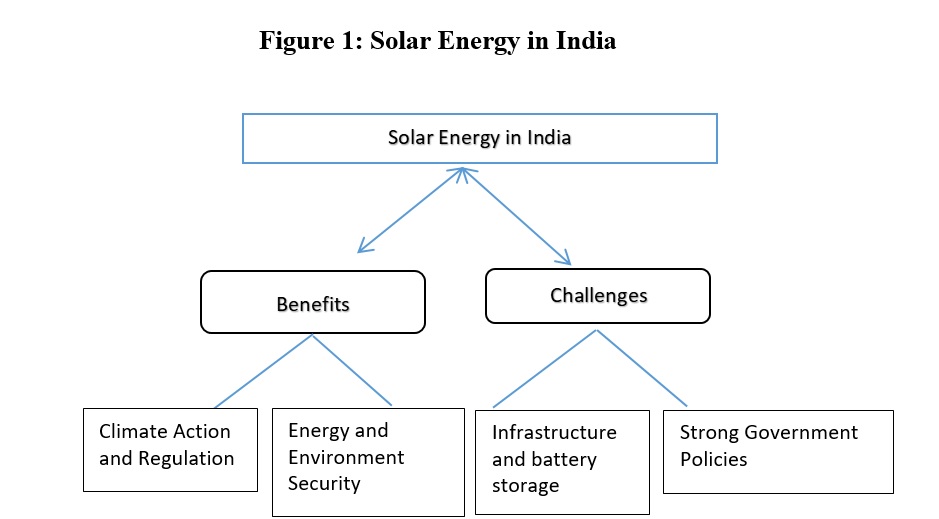
The solar energy sector in India has experienced significant expansion in recent years because multiple states have strengthened their pursuit of sustainable clean energy. Various ambitious policies, together with innovative schemes and strategic solar infrastructure funding, have enabled intense national and state collaborations, leading to remarkable progress in solar energy.
Dynamics of Energy Supply and Demand: India now ranks third in the world for energy consumption, having quadrupled its usage since 2000 (International Energy Agency (IEA), 2021). The level of energy consumption is expected to rise following this worldwide recession of economic activities
Reliability and Consumption of Power: The relationship between energy imports and national threats has consequences for national security. Since more than 80% of India's needs are met by imports, the nation is vulnerable to fluctuations in the price of crude oil due to its large reliance on imports. Given that geopolitical tensions have the potential to disrupt energy sources, such a dependence raises several concerns about energy security.
Environmental Considerations: Climate change has a dual impact on energy security: while changing climatic patterns negatively impact energy generation and transmission, India is committed to switching towards renewable energy due to its increasing carbon footprint (Ministry of Science & Technology, 2023). Making the switch to solar power can cut greenhouse gas emissions dramatically. According to estimates, if India meets its solar ambitions, more than a billion tonnes of CO2 emissions might be avoided by 2030 (The Hindu, 2023).The devastation of the environment brought about by the combustion of fossil fuels has increased the pressure on India to switch to greener energy sources. Public health emergencies result from large cities' air quality frequently falling below acceptable limits. Air quality will be improved, greenhouse gas emissions will be drastically reduced, and climate change will be fought by solar energy. According to studies, a deliberate switch to solar energy might lead to a sharp drop in carbon dioxide emissions, aiding in the Paris Agreement's goal of keeping global warming to 1.5°C over pre-industrial levels.
Approximately 70% of India's overall emissions are caused by the energy sector (Government of India, 2024). India can drastically reduce its carbon footprint by increasing the proportion of renewable energy. For example, according to a report by the Council on Energy, Environment, and Water (CEEW), India could prevent an estimated 3.4 gigatons of CO2 emissions by 2030 if it meets its renewable energy targets (Council of Energy, Environment and Water (CEEW), 2023).
Solar Power is Nature's Revolutionary Potential
The accessibility of resources: India is one of the best places in the world to produce solar energy, with an average daily sun radiation of 5-7 kWh/m². It receives about 5,000 trillion kWh of energy annually, which is more than 80,000 times its entire energy requirements (Energy Efficiency & Renewable Energy Management Centre, n.d). With a goal of achieving 100 GW of solar power by 2022, the National Solar Mission was initiated in 2010 with the intention of making India a global leader in solar energy. India has exceeded 60 GW of installed solar capacity as of 2023, putting great progress towards this challenging goal (Mundhra, 2023). India boasts abundant solar energy resources, with an estimated 300 days of sunshine annually. It has the potential to generate more than 750 GW of solar energy, which is still mainly untapped and might contribute to the expansion of the availability of energy sources.
Advancements in technology: Solar energy is feasible due to advancements in solar photovoltaic (PV) technology, particularly the increased global efficiency rates and decreased costs of solar power. Enhancements in battery storage and smart grid technology have the potential to augment the dependability and efficiency of solar-powered systems.
National Security and Renewable Energies from the Sun
Energy Self-Sufficiency: A large-scale solar sector can significantly aid India's energy independence, particularly with regard to its reliance on oil imports. Encouraging local solar energy generation boosts the country's power and security because it remains unaffected by fluctuations in the global market.
The creation of jobs and economic growth are two greater advantages of the solar industry: The solar business contributes to economic growth by increasing the amount of power produced using renewable energy, which in turn increases job opportunities for individuals. The solar industry has the potential to create millions of employments and maintain social stability by reducing the wealth gap, both of which are vital for national security.
Implementing the Climate Change Transition and moving to solar energy can lessen the effects of climate change and increase a country's resilience. By mitigating the effects of climate-related disasters, a proactive approach to sustainable energy can improve governance continuity and stability as well as service delivery.
Electricity in Rural Areas
With around 300 million people living in countries without access to electricity, solar energy offers a lot of promise for distributed energy solutions (International Finance Corporation [IFC], 2018). Off-grid solar power systems can raise living standards and open doors for small business owners and farmers by giving rural communities access to energy. In addition to offering access to clean energy, enhancing livelihood prospects, and lowering dependency on kerosene and other dirty energy sources, solar energy can be extremely important in energizing isolated and rural areas.
Geopolitical Framework India's geopolitical situation can be improved by rising to the forefront of the solar energy industry. Establishing strategic alliances for commerce and technology transfer with nations that distribute solar technology will strengthen India's standing in international forums.
Obstacles and recommendations
The price of raw materials
Materials like polysilicon, silver, and other rare metals are necessary for the construction of solar panels, but their costs might change depending on market conditions (MIT Technology Review, 2023). Such fluctuations might affect long-term planning for renewable projects as well as the ultimate cost of solar installations.
Investment and Financing: Large sums of initial aid are needed for solar plants. It is imperative that the Indian government investigates novel financing methods such as international financing, green bonds, and public-private partnerships (PPPs).
Development of Infrastructure India has to invest in strong infrastructure, including as transmission networks and energy storage systems, in order to achieve its solar potential. Modernization of the grid is necessary in order to incorporate renewable energy sources.
Land Purchase
To satisfy the energy needs of large countries especially like India it requires a large-scale solar project which requires a vast land with no serious issues like terrorism, or socio-political problems. For example, if a land is identified in border areas neighboring state should not pose serious challenge or identify as target to destabilize the state. Not only should that it never disturb the agricultural production of state which is the backbone of any economy. To reduce such threats the ruling government, opposition parties, policymakers should give land surveys and community involvement top priority to install solar panels in order to have uninterrupted energy supply.
Policy and Regulatory Framework: India’s Solar Policy and Regulatory framework (Ministry of New and Renewable Energy, n.d.) is playing a very vital and significant role in shaping India’s transition to sustainable energy. This does not provide incentives in the form of financial subsidies but also in tax benefits too to increase indigenous manufacturing capabilities. To further encourage investment in solar projects, the Indian government has established a number of financial instruments, including the National Clean Energy Fund and the Solar Energy Corporation of India (SECI). The regulatory framework encourages residents and commercial users to generate their own solar power is a welcoming step.
Simplification of Clearances: The process of obtaining permits and clearances for solar projects in India ensures environmental standards along with several critical steps like permissions, approvals and clearance from the government before implementation. Reducing bureaucracy should streamline this process and shorten the time it takes to go from proposal to implementation.
The National Action Plan on Climate Change includes the National Solar Mission (NSM) project (International Energy Agency [IEA], n.d.), which focuses on solar energy, energy efficiency, sustainable agriculture etc., to reduce greenhouse gas emissions. The effectiveness lies in the overall cooperation and collaboration among the public, private and civil societies and not just a top-down approach.
State-Level Solar Policies: The state level policies in India plays a crucial role in transforming India from the use of nonrenewable to renewable. The effectiveness of these policies is further enhanced with its geographical advantages. However, issues like grid infrastructure deficiencies and need for workforce development with the necessary skill sets still remains challenging.
The Solar Parks Scheme (Energy Proral, n.d.) was implemented by the government to establish large-scale solar power generation facilities that produce electricity to meet the people demand. The main purpose is to have energy independence and rural electrification. The overall vision is to create a cleaner and greener India for sustainable future.
International Partnerships: With natures gift India is one of the sunniest countries in the World which has helped India to emerge as a global leader in Solar Energy. India is constantly engaged in bilateral and multilateral agreements focusing on International Solar Alliance (ISA), which India co-founded, bring together nations with abundant solar resources to promote cooperation in the use of solar technology to address the pressing issues of climate change.
Public Knowledge and Involvement: Public acceptance and awareness is essential for sustainable energy future. Advocating Solar Energy and helping to bridge the knowledge gap in the rural areas is very much required to have public involvement in understanding energy’s economic and environment advantages. If public knowledge of solar energy increases there will be an increase in participation from the public side which strengthens the government solar initiatives.
Collaboration with Academia: Interdisciplinary research is being conducted at various universities, colleges and research centres to maintain India’s competitiveness in the global solar energy landscape. This extends to joint research projects, internship which equip with practical skills. Students with hands-on experience in real world applications will definitely prepare next generation engineers, scientists and policymakers to address these challenges. The academic innovations turn into marketable solutions to adopt solar technologies worldwide.
Awareness Campaigns: Public interest in solar energy can be increased by government-led campaigns that inform the public about the advantages of solar energy, subsidies, and installation procedures.
Workshops and Training: Technical training for engineers, technicians, and installers can boost the skills of the local labor force and encourage the creation of jobs in the solar industry.
Conclusion
India’s Energy needs are expanding rapidly, driven by increase in population, industrial development and rising standard of living. At the same time, India is facing several critical challenges like dependence on import fossil fuels, regional power shortage and urgent need to address greenhouse gas emission. Ensuring energy security by supporting economic growth requires a transition towards cleaner, reliable and domestically available energy sources. Solar energy is a plentiful, renewable resource that can help India fulfil its expanding energy needs and open the door to a sustainable future. Therefore, India’s energy landscape is undergoing a transformative shift. India stands to gain significant economic and social advantages in addition to lowering its carbon footprint by switching to sustainable energy sources.
Energy independence is a key component of modern national security rhetoric, and it is intimately related to ecological sustainability, geopolitical stability, and economic resilience. Among other renewable energy sources, solar energy stands out as a viable choice due to its widespread availability, quick technological breakthroughs, and declining costs. However, achieving Solar full potential needs capacity expansion, continued policy stability, integrated infrastructure development and innovation in energy storage systems, greater emphasis on domestic manufacturing and expanding incentives for rooftop and rural solar adoption.
Solar energy is not merely a supplement resource for India it is a game-changer to meet future energy demands sustainable. Government, industry players, and civil society must work together to establish a robust and sustainable solar energy ecosystem that aligns with India's energy security and climate goals. As India moves further on its path towards sustainable development, solar energy is emerging not only as a replacement for traditional energy sources but also as a cornerstone for a future that is cleaner and more resilient to climate change. By making investments in solar infrastructure and technology, India can lead the world's shift to renewable energy sources and demonstrate its commitment to both environmental responsibility and economic growth. These measures will not only support national energy goals, but also position India as a trend setter in the clean energy transition.
Disclosure Statement: The Author Dr.O.Nirmala is thankful to the Guru Nanak College Centre for Research for the financial support under Seed Money Grant (File No:GNC/GNCR/SMG_2023-24/021 dated 10.04.2024)
References:
Council on Energy, Environment and Water. (2023). Peaking and net-zero for India’s energy sector CO2 emissions. CEEW. https://www.ceew.in/publications/how-can-india-attain-net-zero-emissions
Economic Times EnergyWorld. (2025, June 20). India’s power generation: 49% non-fossil fuel capacity achieved; solar leads. Retrieved January 16, 2026, from https://energy.economictimes.indiatimes.com/news/power/indias-power-generation-49-non-fossil-fuel-capacity-achieved/122013763
Energy Efficiency & Renewable Energy Management Centre, Government of NCT of Delhi. (n.d.). Solar energy. Government of Delhi. https://eerem.delhi.gov.in/eerem/solar-energy
Energy Portal. (n.d.). Solar park scheme. Energy Portal https://www.energyportal.in/solar/solar-park-scheme
International Energy Agency. (2021). India energy outlook 2021. IEA. https://www.iea.org/reports/india-energy-outlook-2021
International Energy Agency. (2025). Global Energy Review 2025: CO₂ Emissions. IEA. Retrieved January 15, 2026, from https://www.iea.org/reports/global-energy-review-2025/co2-emissions
International Energy Agency. (n.d.). Jawaharlal Nehru National Solar Mission: Phase I, II, and III. IEA. https://www.iea.org/policies/4916-jawaharlal-nehru-national-solar-mission-phase-i-ii-and-iii
International Finance Corporation. (2018). India Rewa solar power park PPP. IFC. https://www.ifc.org/content/dam/ifc/doc/2010/2018-india-rewa-solarppp-brief.pdf
Ministry of External Affairs, Government of India. (2023, February 6). Universalization of the membership of the International Solar Alliance (ISA). Government of India. https://www.mea.gov.in/press-releases.htm?dtl/32866/Universalization_of_the_Membership_of_the_International_Solar_Alliance_ISA
Ministry of New & Renewable Energy. (2025). India achieves 50 % non-fossil fuel power capacity five years ahead of Paris Agreement target [Press release].
Ministry of New and Renewable Energy. (n.d.). Solar RPO and REC framework. Government of India. https://mnre.gov.in/solar-rpo-and-rec-framework/
Ministry of Science & Technology. (2023, June 20). Press release. Press Information Bureau, Government of India. https://pib.gov.in/PressReleaseIframePage.aspx?PRID=1961797
Ministry of Statistics and Programme Implementation. (2023). Energy statistics India 2023. Government of India. https://www.mospi.gov.in/sites/default/files/publication_reports/Energy_Statistics_2023/EnergyStatisticsIndia2023.pdf
Ministry of Statistics & Programme Implementation. (2025). Energy Statistics India 2025 (MoSPI). Government of India. Retrieved from https://static.pib.gov.in/WriteReadData/specificdocs/doc202543532301.pdf (Press Information Bureau)
Ministry of Statistics and Programme Implementation. (2024). Energy statistics India 2024. Government of India. https://www.mospi.gov.in/sites/default/files/publication_reports/EnergyStatistics_India_publication_2024N.pdf
Mundhra, J. (2023, April 5). India’s solar saga: From potential to powerhouse. Upstox. https://upstox.com/news/upstox-originals/investing/india-s-solar-saga-from-potential-to-powerhouse/article-123819/
Press Information Bureau. (2025). Year end review of rooftop solar programmes in India. Government of India. Retrieved from https://pib.gov.in/PressReleasePage.aspx?PRID=1992732 (Press Information Bureau)
The Hindu. (2023, March 23). India’s climate policies expected to reduce CO2 emissions by around 4 billion tonnes by 2030. The Hindu. https://www.thehindu.com/sci-tech/energy-and-environment/indias-climate-policies-expected-to-reduce-co2-emissions-by-around-4-billion-tonnes-by-2030-report/article68841062.ece
Technology Review. (2023, January 31). Climate change and energy: We have enough materials to power the world with renewables. MIT Technology Review. https://www.technologyreview.com/2023/01/31/1067444/we-have-enough-materials-to-power-world-with-renewables/
Times of India. (2025, Jan 10). India adds 48 GW of renewable energy capacity in 2025. Times of India. Retrieved from https://timesofindia.indiatimes.com/business/india-business/india-adds-48-gw-of-re-capacity/articleshow/126446424.cms (The Times of India)
United Nations. (n.d.). Climate action: Renewable energy. UN.org. https://www.un.org/en/climatechange/raising-ambition/renewable-energy
United Nations. (n.d.). Sustainable development goal 7: Affordable and clean energy. UN.org. https://www.un.org/sustainabledevelopment/energy/
U.S. Department of Commerce. (n.d.). India - country commercial guide: Renewable energy. Trade.gov. https://www.trade.gov/country-commercial-guides/india-renewable-energy