ELECTRONIC JOURNAL OF SOCIAL AND STRATEGIC STUDIES - Volume 6 Issue 3, Dec 2025-Jan 2026
Pages: 463-479
Date of Publication: 31-Jan-2026
Print Article
Download XML Download PDF
Investigating the factors of divergence in Afghanistan-Pakistan relations during the Second period of the Islamic Emirate of Afghanistan
Author: Ehsanullah Ehsan
Category: Regional/Country Studies
Abstract:
Abstract Afghanistan and Pakistan, as neighboring states, share deep historical, linguistic, ethnic, cultural, and religious commonalities. However, since the establishment of Pakistan in 1947, bilateral relations between the two countries have remained largely tense and unstable. Following the return of the Islamic Emirate to power in August 2021, relations initially showed signs of improvement but subsequently deteriorated due to multiple factors. The purpose of this study is to examine the key factors contributing to divergence in Afghanistan–Pakistan relations during the second period of the Islamic Emirate of Afghanistan. The central research question seeks to identify the divergent factors influencing the bilateral relationship in this period. The findings reveal that several issues have played a decisive role in driving divergence in Afghanistan–Pakistan relations. Chief among these is the contentious Durand Line, which Afghanistan has consistently refused to recognize it as a legitimate boundary. The Tehreek-e-Taliban Pakistan issue has further aggravated distrust, as Pakistan accuses the Afghan Taliban of providing sanctuary to the group, while Afghanistan denies the allegations. The presence of Afghan refugees in Pakistan, trade and transit challenges and Afghanistan’s growing engagement with India are another factors that intensified the divergence in Afghanistan–Pakistan relations. This qualitative research employs a descriptive–analytical approach, drawing on data collected from credible academic sources such as books and peer-reviewed journal articles, following a bibliographic research design.
Keywords: Keywords: Afghanistan, Pakistan, Islamic Emirate, Foreign Policy, Bilateral Relations.
DOI: 10.47362/EJSSS.2026.6305
DOI URL: https://doi.org/10.47362/EJSSS.2026.6305
Full Text:
Introduction
Afghanistan has had a complex relationship with Pakistan for decades, which has passed many ups and downs. Throughout history, Pakistan has maintained tense, hostile, and sometimes ambiguous relations with Afghanistan, and the two countries have not yet established good and friendly relations as needed. While the two countries have strong historical, linguistic, religious, and cultural commonalities with each other. The issue of the hypothetical Durand Line has remained as the biggest issue in the relations between the two countries, which has always negatively affected the relations between the two countries. Afghanistan does not recognize the Durand Line and does not have any agreement with Pakistan to determine the border between the two countries. Afghanistan considers all Pashtun-dominated areas beyond the Durand Line its own territory and considers the Durand Line as an imposed line by British colonialism, which has no legal legitimacy and has been rejected by all governments in Afghanistan. Pakistan considers the Durand Line as its official border with Afghanistan and has always tried to dissuade Afghanistan from its claim (Qassem & Durand, 2008). Owing to the Durand Line issue, relations between the two countries have remained tense for many years, and sometimes have even been cut off. Afghanistan relies on Pakistan for its trade and transit routes, and Pakistan without any logical reason, always closes its trade and transit routes to Afghanistan and uses this factor as a means of pressure on the Afghan government. While the United Nations, in its Resolution 2625, recommends that countries establish friendly relations based on cooperation with each other and not interfere in each other's internal affairs, this is a violation of international law (United Nations General Assembly, 1970). With the return of the Islamic Emirate of Afghanistan to power on August 15, 2021, Afghanistan’s relations with Pakistan initially improved, and the prevailing belief was that Pakistan had achieved its goal of strategic depth in Afghanistan. The then Prime Minister of Pakistan, Imran Khan, said that the people of Afghanistan had broken the “chain of slavery.” Pakistani Defense Minister Khawaja Asif celebrated the Taliban’s victory on Twitter by writing “Allahu Akbar.” Former ISI chief General Faiz Hamid, holding a cup of coffee in Serena Hotel in Kabul, said, 'Don’t worry, everything will be okay'. The Taliban’s victory in Afghanistan was considered a victory for Pakistan, but later, the equation was reversed, and strategic depth turned into a strategic threat (Amiri, 2023).
This study contributes to the academic and policy-oriented understanding of Afghanistan–Pakistan relations by offering a focused analysis of the divergence factors. Understanding these factors is crucial for anticipating future developments and fostering a stable relationship between Afghanistan and Pakistan. Despite extensive scholarship on Afghanistan–Pakistan relations, most studies have historically focused on the first period of Taliban rule (1996–2001), and the Cold War-era dynamics. While there is considerable literature on enduring disputes such as the Durand Line, cross-border militancy, and refugee flows, few studies have systematically examined these factors in the context of the second period of the Islamic Emirate of Afghanistan.
The primary objective of this study is to analyze and identify the key factors contributing to divergence in Afghanistan–Pakistan relations during the second period of the Islamic Emirate of Afghanistan. The research aims to provide a comprehensive understanding of the structural and contextual causes of tension between the two neighboring states. The central research question guiding this study is: What are the primary factors that have contributed to divergence in Afghanistan–Pakistan relations during the second period of the Islamic Emirate of Afghanistan?
Research Method
This study adopts a qualitative, descriptive–analytical research design. Data were collected through an extensive review of secondary sources, including scholarly books, peer-reviewed journal articles, policy papers, and official documents. The bibliographic approach allowed for the systematic identification and analysis of recurring themes and patterns that explain the persistent divergence between Afghanistan and Pakistan.
The findings indicate that multiple interrelated factors have contributed to the deterioration of bilateral relations. Foremost among these is the Durand Line dispute, which continues to serve as a major source of political, legal, and security tension between the two states. The presence and activities of the Tehreek-e-Taliban Pakistan (TTP) represent another critical point of contention, as Pakistan accuses the Afghanistan of providing sanctuary and operational space to the group, an allegation that Afghan authorities consistently deny. The status of Afghan refugees residing in Pakistan also remains a persistent humanitarian and security concern, influencing both domestic politics and bilateral perceptions. Furthermore, ongoing trade and transit restrictions have constrained economic cooperation. In addition, Afghanistan’s growing engagement with India is perceived by Pakistan as a strategic and security challenge, further intensifying mutual suspicion. Collectively, these factors have reinforced structural mistrust and continue to obstruct the development of constructive diplomatic relations between the two countries.
Historical Background of Afghanistan-Pakistan Relations
Since the creation of Pakistan in 1947, Afghanistan's relations with Pakistan have always been full of disagreements, distrust, and crises. While both countries have religious, cultural, and ethnic commonalities with each other. In 1947, when the Indian subcontinent was divided into India and Pakistan, and Pakistan as a new country was formed, Afghanistan opposed it due to its territory. Hussain Aziz, Afghanistan's representative to the United Nations, voted against Pakistan's membership and said that (we cannot consider the North-West Province as part of Pakistan's territory until the people of this region have been given full authority without pressure and interference, to remain independent or to join Pakistan), (Baqai & Wasi, 2021). In retaliation, Pakistan imposed a trade embargo on Afghanistan and restricted Afghanistan's access to international markets (Schofield, 2010). Pakistan was trying to dissuade Afghanistan from its territorial demands and support for the Pashtunistan movement. Since then, the two neighboring countries have not had good, harmonious, and acceptable relations with each other. In 1949, King Mohammad Zahir Shah convened a Loya Jirga, "great council," which landed support for Pashtunistan and nullified all agreements, including the Durand line that were signed with British India. Because at that time, Afghanistan was a British colony, and according to international law, making an agreement with a colonial country has no legal legitimacy. Based on the decision of the Jirga, the Afghan government began supporting the Pashtunistan movement, and then Pashtunistan Day was celebrated on August 31 every year (Bezhan, 2014). Thereafter, the officials of both countries adopted opposing positions towards each other, and the relationship between the two countries was based on distrust. In addition to the Durand Line, Pashtunistan was another important issue that affected the relations between the two countries. In the first decades of bilateral relations, the Pashtunistan issue was the main axis of Afghanistan's foreign policy. The Pashtunistan movement gained momentum during the Cold War, in which Afghanistan was trying to find supporters on the Pashtunistan issue. The former Soviet Union, as a close ally of Afghanistan, supported the Afghan policy of weakening Pakistan as a key ally of the United States (Jaffer, 2024). According to political experts, it was due to Afghanistan's strong support for the Pashtunistan movement that Afghanistan became politically and economically dependent on the Soviet Union bloc, and later came under its invasion in 1979 (Qassem & Durand, 2008). During the Daoud Khan era, the Pashtunistan issue became more serious, and for the first time, Afghanistan moved its army closer to the Durand line, and Pakistan also moved its army closer to the line. This confrontation of forces encouraged Zulfikar Ali Bhutto to support Burhanuddin Rabbani, Ahmad Shah Massoud, and Gulbuddin Hekmatyar against the Daud Khan Government. Pakistan set up training camps for them in Razmak, Waziristan, under the supervision of Nasirullah Babar, to fight against the Daud Khan Government (Hussain, 2005). In a similar move, the Afghan government also supported the rebellions in Balochistan and parts of the Frontier Province. Thus, in the 1970s, the relations between the two countries continued with support for each other's opponents (Khan, 2003). When the Soviet Union invaded Afghanistan on December 24, 1979, the United States reflected the invasion as the greatest threat to international peace since World War II. Pakistan became a frontline state, and the US provided it millions of dollars in aid to organize Afghan mujahideen groups against the Soviet Union, which further strained Afghan-Pakistani relations. During the Soviet invasion of Afghanistan, with the financial support of the United States and Saudi Arabia, Pakistan found an opportunity to establish a government in Kabul to would be friendly to Pakistan, hostile to India, and not raise the Durand Line issue against Pakistan (Siddiqi, 2008). At the same time, Pakistan developed its strategic depth policy towards Afghanistan. Pakistan's support for the Afghan Mujahideen in the 1970s and 1980s was a strategic goal, not an ideological one. Because General Zia-ul-Haq used religion as a motivating factor only (Pakistan Institute of Peace Studies, 2023). Dr. Najibullah came to power at a time when the Soviet Union had accepted its defeat in Afghanistan and was busy organizing a timetable for the withdrawal of its troops. Dr. Najibullah tried his best to reach peace with the Mujahideen, but to no avail. Pakistan saw itself in a better position than the Afghan government and did not allow the Mujahideen to reconcile. Dr. Najibullah's government collapsed in April 1992, which resulted power vacuum, civil war broke out, and Pakistan achieved its goal, which ISI Chief Akhtar Abdul Rahman often said, Kabul must be burned (Coll, 2004). During the civil wars between the Mujahideen, Pakistan tried to bring a non-Pashtun party out of the seven political parties to powerand could solve the Durand Line issue permanently with it. But internal disputes among Mujahideen intensified, and finally, Afghanistan was deprived of a central government. In 1994, the Taliban emerged and captured Spin Boldak and other areas of Kandahar, Herat in 1995, and Kabul and Jalalabad in 1996. After capturing Kabul, the Taliban established the Islamic Emirate of Afghanistan under the leadership of Mullah Mohammad Omar Mujahid. Pakistan recognized the Islamic Emirate of Afghanistan on May 25, 1997, and two days later, Saudi Arabia and the United Arab Emirates also recognized it (Hussain, 2005). By recognizing and supporting the Islamic Emirate, Pakistan wanted to solve its security problems with India, prevent Pashtun nationalism, and create a trade corridor with Central Asia through Afghanistan. Though Pakistan achieved some of its goals for a short time, but could not convince the Islamic Emirate to accept the Durand Line as the international border between the two countries (Rubin, 2002). When the 9/11 incident happened, Pakistan immediately changed its policy towards the Islamic Emirate 180 degrees and, contrary to the principles of good neighborliness, gave all its air and land space to the United States in the war in Afghanistan. It arrested the leaders of the Islamic Emirate and handed over some of them to the United States in exchange for money (Baqai & Wasi, 2021). Mullah Obaidullah, the Minister of Defense of the Islamic Emirate, was killed in a Pakistani prison. Mullah Abdul Ghani Baradar, the current Deputy Prime Minister of the Islamic Emirate, was imprisoned, and Ustad Yasir, one of the influential persons of the Islamic Emirate, was arrested, and to this day, there is no information about his life or death (Amiri, 2023). With this cooperation, Pakistan removed the discontent of the United States and the West that had arisen over nuclear tests and Pervez Musharraf's military coup in 1999, and on the other hand, it tried to play a role as an important and influential country in the future democratic system of Afghanistan and compete with India. In 2001, India opened its embassy in Afghanistan and later consulates in Jalalabad, Kandahar, Herat, and Mazar-e-Sharif. It trained Afghan forces in India and signed a Strategic Partnership Agreement with Afghanistan in October 2011 (BBC News, 2011). India focused on economic development and humanitarian assistance in Afghanistan, with a strong soft power approach. It invested more than $3 billion in various infrastructure projects in Afghanistan, including the Salma Dam, the Zaranj-Delaram Highway, and the Afghan parliament building, and was the fifth largest donor to Afghanistan (Muraleedharan, 2022). Pakistan was always concerned about India's growing influence in Afghanistan, believing that India is less involved in humanitarian aid and development work in Afghanistan and more in intelligence activities against Pakistan (Baldauf, 2003). Pakistan decided to continue its double game in Afghanistan. On one hand, it cooperated with the US in arresting Taliban members and sharing intelligence information. On the other hand, it continued to support the Taliban against the Afghan government. This double game of Pakistan against Afghanistan continued until the restoration of the Islamic Emirate in August 2021.
Factors of divergence in Afghanistan-Pakistan relations
The Durand Line
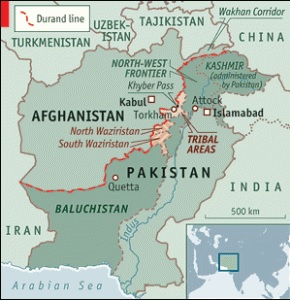
Afghanistan's bilateral relations with Pakistan since 1947 have always been fraught with tension, and the Durand Line issue has played a significant role in it. The Durand line, as a legacy of British colonialism, arose in 1893, when Abdul Rahman Khan, the ruler of Afghanistan, under British pressure, signed the Durand Line Agreement with British India, which is 2,640 kilometers long (Khunte, 2022). According to this agreement, the spheres of influence of Afghanistan and British India were defined, and both sides agreed not to interfere in each other's territory beyond the hypothetical line. This agreement was formalized for a hundred years, which later divided the Pashtun nation into two parts (Bahar, 2021).
Fig 1: Disputed Border (Durand line)
Source: https://afghanhindsight.wordpress.com
Note: Picture highlights the Durand Line
When British India was divided into two parts of India and Pakistan, in 1947, Afghanistan immediately demanded the return of its territory from Pakistan, which strained relations between them. It was because of this demand that Afghanistan opposed Pakistan's membership in the United Nations, and therefore, the relations between the two countries started on an unfriendly basis. In 2017, Pakistan started fencing the border with barbed wire along the Durand Line, which the Afghan government opposed, and several clashes between the two sides have occurred. Afghanistan does not recognize the Durand Line as an international border and considers Pakistan's action arbitrary and illegal. Pakistan, on the other hand, considers the Durand Line as an international border, arguing that the barbed wire is on their own side, and it is their right to build this fence to prevent illegal movement (Deutsche Welle, 2021). With the return of the Islamic Emirate to power on August 15, 2021, Pakistan had the expectation to complete the construction of barbed wire along all Durand Line, but faced the opposition of the Islamic Emirate forces. The Islamic Emirate does not recognize the Durand Line and considers it an imposed line and a legacy of colonialism that has divided the one Pashtun nation into two parts. In February 2024, regarding the Durand line, the Deputy Foreign Minister of Afghanistan, Sher Mohammad Abbas Stanikzai, in Logar, said: "We have never recognized the Durand Line. Half of Afghanistan is beyond the Durand Line, and travel with a visa and passport over this line is absolutely unacceptable." Mumtaz Zahra Baloch, the spokesperson of Pakistan's Ministry of Foreign Affairs, reacted to these statements and called these statements imaginary and far from ground realities (BBC News Pashto, 2024). In addition to these diplomatic disagreements, several clashes between the two sides have occurred in different areas along the hypothetical Durand Line, which have caused casualties on both sides. Such as the clash of Kunar in January 2024 and the clash of Zazai Maidan district of Khost province on September 8, 2024, (BBC New Pashto, 2024) and October 12-18, 2025 war in which both sides used light and heavy weapons against each other. Overall, the Durand Line still remains a controversial issue and a divergence that has negatively affected relations between the two countries.
Tehreek-e-Taliban Pakistan
Tehreek-e-Taliban Pakistan (TTP) emerged in 2001, when the United States invaded Afghanistan, and requested Pakistan's assistance and military operations against al-Qaeda. Pakistan took advantage of this opportunity and launched operations against al-Qaeda in the Federally Administered Tribal Areas (FATA), which includes the seven agencies of Bajaur, Mohmand, Orakzai, Khyber, Kurram, North Waziristan, and South Waziristan, and Provincially Administered Tribal Areas (PATA), which includes the districts of Swat, Upper and Lower Dir, Buner, and Shangla. It was the first time that Pakistan sent its forces to the region in 2001-2002 (Khan, 2011). Pakistan’s bombings, killings, and destruction in the tribal areas led Baitullah Mehsud to form the TTP in 2007, which now encompasses various armed groups. The TTP aims to overthrow the Pakistani government and establish an emirate based on Islamic law. US-led drone strikes killed Baitullah Mehsud in 2009 and his successor Hakimullah Mehsud in 2013. Noor Wali Mehsud currently leads the group, replacing Mullah Fazlullah, who was killed in a drone strike in 2018. The TTP has helped recruit and provide safe havens to Afghan Taliban fighters during US US-led NATO war in Afghanistan (Banerjee, 2025). In recent years, TTP attacks on Pakistani forces have increased, and Pakistan has consistently blamed and accused the Islamic Emirate of supporting the TTP, which has further strained relations between the two countries. In May 2022, the Islamic Emirate of Afghanistan mediated talks between the Pakistani Taliban and the Pakistani government in Kabul with the intention of goodwill and cooperation. Both sides agreed to a temporary ceasefire in these talks, and TTP made two major demands from the Pakistani government, which were the withdrawal of Pakistani military forces from the FATA and the cancellation of the merger of the FATA with Khyber Pakhtunkhwa. Since Pakistan did not implement the decisions made in the talks, the TTP broke the ceasefire and continued fighting against Pakistani troops (ORF Online, 2022). On July 18, 2023, Pakistani Interior Minister Rana Sanaullah claimed that Afghanistan had become a safe haven for the TTP and they attack Pakistan from there (TOLOnews, 2024). On September 26 of the same year, Pakistani Acting Prime Minister Anwarul Haq Kakar also claimed that there are training camps for the TTP in Afghanistan, and we are facing a threat from Afghanistan. Regarding these statements, Zabihullah Mujahid, spokesman of the Islamic Emirate, said that “Afghanistan’s soil is not a threat to any country and Afghanistan does not want to interfere in the internal affairs of any country. The Islamic Emirate wants good relations with all countries, including Pakistan” (Shinwari, 2025). On December 24, 2024, Pakistani jets bombed several areas in the Barmal district of Paktika, Afghanistan. Pakistani officials claimed that 71 terrorists were killed in the airstrikes, but the Islamic Emirate said that 46 civilians, mostly women and children, were killed in the attacks. The United Nations Mission in Afghanistan (UNAMA) confirmed the Islamic Emirate’s claim of civilian casualties (UNAMA, 2025). During this bombardment, a delegation led by Pakistan’s Special Representative for Afghanistan, Mohammad Sadiq, was engaged in talks with Afghan officials in Kabul to expand bilateral trade and improve relations, but these airstrikes damaged diplomatic relations and limited the possibility of any talks with the Islamic Emirate on the TTP or other issues. On the 28th of the same month, Islamic Emirate forces targeted several points beyond the hypothetical Durand Line in retaliation, and all these incidents further strained relations between the two countries (Ahlawat, 2024).
Afghan refugees
The migration of Afghans to Pakistan began with the invasion of Afghanistan by the former Soviet Union in 1979 and continued during the civil war. Since then, Pakistan has always used the Afghan refugees issue as a means of pressure against Afghanistan, but on October 3, 2023, it changed its policy on Afghan refugees and set a one-month deadline for the deportation of Afghan refugees. On October 3, 2023, Pakistani Interior Minister Sarfaraz Bugti announced that all illegal Afghan refugees must leave the country by November 1 of this year, otherwise they will face forced deportation. He claimed that 14 of the 24 suicide attacks this year were carried out by Afghan nationals (Shahzad, 2023). According to Sarfaraz Bugti, there are 4.4 million Afghan refugees living in Pakistan, and according to a UN report, only 1.3 million of them have legal residency documents in Pakistan (UNHCR, 2025). After the expiration of a one-month deadline on November 1, the Pakistani government began the operation to arrest and forcibly deport more than one and a half million Afghan refugees. Thousands of Afghan refugees have been arrested by the Pakistani police and forcibly deported to Afghanistan, a process that is still ongoing. In this regard, officials of the Islamic Emirate requested Pakistan to stop this process, but the Pakistani government did not heed their requests. The Prime Minister of the Islamic Emirate, Mullah Mohammad Hassan Akhund, addressed Pakistani officials: "If you have a problem with our government, then talk to them. What is the fault of the refugees? The problems with the government should not be retaliated against by Afghan refugees who have passed a very difficult life in Pakistan for the past four decades", (Stanikzai, 2023). These statements clearly show that the Islamic Emirate also believes that the plan to forcibly deport Afghan refugees is a political reaction and a means for Pakistan to put pressure on the Afghan government. Pakistan opted for this policy towards Afghan refugees based on political, economic, and security reasons. Pakistani officials argue that insecurity in Pakistan has increased by 60 percent since the Islamic Emirate came to power and that the Islamic Emirate supports the TTP (Anadolu Agency, 2023). Economically, they argue that Pakistan's economy has weakened, its citizens have become unemployed, and it can no longer allow Afghan refugees to work in Pakistan. Politically, Pakistan wants to put pressure on the Islamic Emirate and finally gain concessions from the Islamic Emirate. That is why Pakistan is forcibly deporting thousands of Afghan refugees to Afghanistan every day, which has further strained Afghanistan-Pakistan relations.
Trade and transit
Afghanistan, as a landlocked country, is largely dependent on Pakistan for its transit and trade routes, but Pakistan often closes its ports to Afghanistan and uses this factor as a means of pressure on Afghanistan. So, Trade and transit have often played a role as a controversial factor in the relations between the two countries. After the restoration of the Islamic Emirate, it was expected that Afghanistan's bilateral trade with Pakistan would improve, but Pakistan resorted to the same policy of putting pressure on Afghanistan as before and increased customs tariffs on the goods of Afghan traders, which Afghan traders were forced to change trade routes from Pakistan to other neighboring countries (IRNA, 2025). Economic relations between Afghanistan and Pakistan exist in three areas of bilateral trade, regional trade, and transit. After 2021, bilateral trade between the two countries increased in the first two years, and the balance of exports and imports was maintained compared to the Islamic Republic period. The main reason for maintaining this balance was the export of coal to Pakistan, but later Pakistan adopted a new economic policy towards Afghanistan that caused losses not only to Afghan traders but to Pakistani traders as well. In regional trade, the APTTA agreement, which was signed in 2010, can play an effective role between the two countries. Based on this agreement, Afghan traders gained access to the Wagah and Gwadar ports of Pakistan to export their goods to India, and Pakistan gained access to Iran, Uzbekistan, Tajikistan, and Turkmenistan through the ports of Islam Qala, Hairatan, Sher Khan Bandar, and Torgundi, respectively (Agreement between the governments of the Islamic Republic of Afghanistan and the Islamic Republic of Pakistan, 2010). In regional transit, Afghanistan can play an important role in the transfer of Central Asian energy to Pakistan and India. For example, the TAPI project, which will transport Turkmen natural gas to Pakistan and India via Afghanistan, and the CASA-1000 project, which will transport electricity from Kyrgyzstan to Pakistan and India. Although the United Nations Convention on the Law of the Sea (UNCLOS) exists and recognizes the right of many countries, including Afghanistan, to use transit routes, Pakistan has consistently violated it and always created obstacles for Afghan trade and transit goods (United Nations, 1982). Pakistan still closes borders, unnecessarily stops trucks at the borders, increases import tariffs during the fresh fruit season of Afghanistan, and Pakistani security officials extort money from Afghan traders, which are considered major challenges for Afghan exports to Pakistan. In recent border clashes that occurred in October 2025, Pakistan has once again closed its commercial ports to Afghan transit trade. On November 12, 2025, the Taliban government’s Deputy Prime Minister for Economic Affairs Mullah Abdul Ghani Baradar called on Afghan traders to seek alternative trade routes other than Pakistan. He said: “If someone has signed a contract in Pakistan to buy medicine, they have three months to clear all their accounts”, (BBC Dari, 2025). Due to this policy of pressure of Pakistan, the annual trade volume between the two countries has decreased from $2.5 billion to $1 billion (Ariana News, 2025). While traders on both sides estimate that if relations between the two countries improve, they have a trade potential of $10 billion (Hussain, 2019). Due to Pakistan's policy of pressure, Afghanistan has changed its trade and transit route to Iran and other neighboring countries. Bilateral trade between the two countries has decreased rapidly, and Pakistan, which was Afghanistan's leading trading partner for many years, has lost the Afghan market, and Iran has become Afghanistan's largest trading partner (Buneri, 2021).
Water
In Afghanistan, water as a national asset has been wasted and has not been utilized for many years. In recent years, Afghanistan has been trying to make effective use of its water and manage it. On the other hand, Pakistan’s economy is based on agriculture, and if Afghanistan manages and controls its water, Pakistan will be affected by it. Therefore, the water issue has become a source of tension in the relations between the two countries. Pakistan disagrees with Afghanistan over the construction of dams in the Kabul River basin. The Kabul River covers nine provinces in Afghanistan and supports the lives of more than 25 million people (Kausar, Iqbal, & Gul, 2022). In Pakistan, the Khyber Pakhtunkhwa province relies on the Kabul River for electricity and agriculture. The total length of the Kabul River is 700 km, of which 560 km is in Afghanistan and joins the Indus River in Pakistan’s Attock district through Jalalabad (Yousaf, 2017). With the assistance of India and the World Bank, Afghanistan plans to build 12 dams on the Kabul River. Pakistan is concerned that these dams will affect the flow of water on the Kabul River. The disagreement over the water of this river increased when the Afghan government began construction of the Shah Tut Dam at a cost of $236 million (Omid, (2018). In December 2023, the Ministry of Water and Energy of the Islamic Emirate of Afghanistan announced that it has a plan to build water reservoirs along the Kunar River, and one of the major projects is the Gamberi Dam project. The dam has the capacity to generate 45 megawatts of electricity and will irrigate 34,000 hectares of agricultural land (TOLOnews, 2023). This announcement of the Islamic Emirate has raised reactions and concerns in Islamabad. Balochistan government spokesman Jan Achakzai said that the Afghan Taliban's unilateral decision to build a dam on the Kunar River will be considered a hostile action against Pakistan, and this will further strain relations between the two countries (Yousafzai, 2024). Afghanistan, as an upstream country, has more control over water resources and seeks to get maximum use of water based on the Harmon Doctrine of Absolute Sovereignty (MCCAFFREY, 1996). Pakistan, on the other hand, believes that it has a historical right to use the water of this river based on the Water Rights Doctrine. These differences have led Pakistan to oppose the construction of dams on the Kabul River, further straining relations between the two countries.
Afghanistan-India relations
Afghanistan has historical relations with India. These historical relations date back to the Indus civilization, when the people of both nations shared cultural, commercial, and religious commonalities. After the division of the Indian subcontinent in 1947, Afghanistan was one of the first countries that recognize the new Indian government and voted positively for membership in the United Nations. The formal foundation of political relations between the two started on January 4, 1950, as a result of the Treaty of Friendship, which historically, both countries have had good and friendly relations with each other (Treaty of Friendship between the Government of India and the Royal Government of Afghanistan, 1950). During the Islamic Republic of Afghanistan, India signed a Strategic Partnership Agreement with Afghanistan on October 4, 2011, which marked a new phase in relations between the two countries, focused on economic development and humanitarian assistance in Afghanistan, based on a strong soft power approach (Agreement on Strategic Partnership between India and Afghanistan, 2011). India invested more than $3 billion in various infrastructure projects, including the Salma Dam, the Zaranj-Delaram Highway, and the Afghan Parliament Building, and was the fifth largest donor to Afghanistan's reconstruction (Muraleedharan, 2022). Pakistan, which has a dispute with India over Kashmir and considers India its historical enemy, viewed India's presence, influence, and increasing involvement in Afghanistan with deep concern and considered it a threat to Pakistan's strategic interests and regional dominance (Zarawr, Alokozay, & Shoukat, 2024). After 15 August 2021, India halted all its development and infrastructure projects in Afghanistan and severed diplomatic relations with Afghanistan. But the Islamic Emirate's neutral, economy-oriented, and balanced foreign policy led India to gradually enter into diplomatic engagement with the Islamic Emirate. Therefore, in June 2022, India sent a delegation led by J.P. Singh, Joint Secretary, Pakistan-Afghanistan-Iran Division, Ministry of External Affairs, to Afghanistan and met with senior leaders of the Islamic Emirate, marking the first sign of a resumption of relations between the two countries (Hussain, 2022). India’s humanitarian aid policy towards Afghanistan and the gradual shift in India’s stance towards the Islamic Emirate have raised hopes for developing India’s relations with Afghanistan, which is considered against the wishes of Pakistan. The appointment of new consul by the Islamic Emirate in Mumbai, India in November 2024, the visit of the Indian External Affairs Ministry representative to Afghanistan, the meeting of the Islamic Emirate Foreign Minister Maulvi Amir Khan Muttaqi with the Indian Deputy Foreign Minister Vikram Masri in the United Arab Emirates in January 2025, the telephone conversation between the Foreign Minister of the Islamic Emirate of Afghanistan, Maulvi Amir Khan Muttaqi, and the Indian Foreign Minister, Dr. S. Jaishankar, following the attack in Pahalgam, Kashmir, and Amir Khan Muttaqi's visit to India on October 9, 2025, are all issues that have caused tension in Pakistan's relations with Afghanistan. Hence, now Afghanistan-India relations are considered a divergent factor in Afghanistan-Pakistan relations, as in previous periods.
Conclusion
Since the establishment of Pakistan in 1947, Afghanistan’s relations with its eastern neighbor have been characterized predominantly by tension, mutual suspicion, and periodic diplomatic estrangement. Despite sharing deep religious, ethnic, and cultural commonalities, the two countries have been unable to develop stable, cooperative, and mutually acceptable relations. Following the return of the Islamic Emirate to power in August 2021, bilateral relations initially appeared to improve. At that time, it was widely assumed that Pakistan had finally achieved its long-sought objective of “strategic depth” in Afghanistan. This perception was reinforced by statements from Pakistani leaders, then Prime Minister Imran Khan declared that the Afghan people had broken the “chain of slavery,” while former ISI Chief General Faiz Hamid, speaking informally in Kabul’s Serena Hotel, assured observers that “everything will be okay.” Consequently, the Taliban’s takeover in Afghanistan was widely interpreted as a strategic victory for Pakistan. However, subsequent developments reversed this equation, transforming what was once perceived as a strategic advantage into a potential strategic threat. Among the most significant factors contributing to this divergence is the contentious Durand Line, a colonial-era boundary that has consistently strained bilateral relations. Afghanistan does not recognize the Durand Line and has no legal or contractual agreement with Pakistan defining the border between the two states. Afghanistan considers the Pashtun-inhabited territories beyond the Durand Line as historically part of Afghanistan and views the line as an illegitimate construct imposed by British colonialism. In addition to the Durand Line dispute, other critical issues including the Tehreek-e-Taliban Pakistan (TTP), transit and trade challenges, the status of Afghan refugees, and water management disputes have further exacerbated tensions between the two countries. Collectively, these factors have contributed to increasing divergence and persistent mistrust in Afghanistan–Pakistan relations.
References:
Agreement between the Governments of the Islamic Republic of Afghanistan and the Islamic Republic of Pakistan. (2010). Afghanistan–Pakistan Transit Trade Agreement (APPTA). https://www.commerce.gov.pk/wp-content/uploads/pdf/APTTA.pdf
Ahlawat, S. (2024, December 29). Afghanistan–Pakistan border war: What is the “hypothetical” Durand Line that the Taliban claims to be crossing & seizing Pak Army posts? Eurasian Times. https://www.eurasiantimes.com/afghan-surgical-strikes-in-pak-taliban-crosses/
Qassem, A. S., & Durand, H. M. (2008). Pak–Afghan relations: The Durand Line issue. Policy Perspectives, 5(2), 87–102. http://www.jstor.org/stable/42909535
Amiri, J. Y. (2023, December 9). Taliban–Pakistan relations: Proxy power or national security threat? BBC Persian. https://www.bbc.com/persian/articles/c0d23rdg7d1o
Anadolu Agency. (2023, August 10). Pakistan claims terrorist attacks up by 60% since the return of the Afghan Taliban to Kabul. https://www.aa.com.tr/en/asia-pacific/pakistan-claims-terrorist-attacks-up-by-60-since-return-of-afghan-taliban-in-kabul/3047202
Ariana News. (2025, June 12). Pakistan–Afghanistan trade shrinks to $1 billion amid border disruptions and policy uncertainty. https://www.ariananews.af/pakistan-afghanistan-trade-shrinks-to-1-billion-amid-border-disruptions-and-policy-uncertainty/
Stanikzai, M. R. A. (2023, November 3). PM Hassan Akhund condemns Pakistan's treatment of expelled Afghans. TOLOnews. https://tolonews.com/afghanistan-185861
Bahar, H. M. (2021). Afghanistan and Pakistan relations: What issues matter? Kardan Journal of Social Sciences and Humanities, 4(1), 1–18. https://kardan.edu.af/data/public/files/KJSSH-4.1-2021-0117072021060331.pdf
Baldauf, S. (2003, September 12). India–Pakistan rivalry reaches into Afghanistan. The Christian Science Monitor. https://www.csmonitor.com/2003/0912/p07s01-wosc.html
Banerjee, S. (2025, January 21). The resurgence of the Pakistani Taliban – Implications for Afghanistan–Pakistan relations. PRIF Blog. https://blog.prif.org/2025/01/21/the-resurgence-of-the-pakistani-taliban-implications-for-afghanistan-pakistan-relations/
Baqai, H., & Wasi, N. (2021). Pakistan–Afghanistan relations: Pitfalls and the way forward (p. 21). Institute of Business Administration. https://ir.iba.edu.pk/faculty-research-books/5
Baqai, H., & Wasi, N. (Eds.). (2021, September). Pakistan–Afghanistan relations: Pitfalls and the way forward [PDF]. Friedrich Ebert Stiftung, Pakistan Office. https://ir.iba.edu.pk/faculty-research-books/5
BBC Dari. (2025, November 12). Abdul Ghani Baradar: Afghans should halt trade and transit with Pakistan. BBC. https://www.bbc.com/dari/articles/cwy5k4lpyj4o
BBC News Pashto. (2024, February 16). [Abbas Stanekzai: Half of Afghanistan lies beyond the Durand Line; Pakistan called the remarks "imaginary" and far from the ground realities]. BBC News Pashto. https://www.bbc.com/pashto/articles/c2l731lgxkgo
BBC News Pashto. (2004, September 8). [Clash between Afghan Taliban and Pakistani forces; both sides used “heavy weapons”]. BBC News Pashto. https://www.bbc.com/pashto/articles/ckgw7rgp2g2o
BBC News. (2011, October 4). Afghanistan and India sign ‘strategic partnership’. BBC News. https://www.bbc.com/news/world-south-asia-15161776
Buneri, A. (2021, March 24). Pakistan loses spot as top trade partner of Afghanistan. Pakistan Today. https://profit.pakistantoday.com.pk/2021/03/24/pakistan-loses-spot-as-top-trade-partner-of-afghanistan/
Coll, S. (2004). Ghost wars: The secret history of the CIA, Afghanistan, and bin Laden, from the Soviet invasion to September 10, 2001. Penguin Books.
Deutsche Welle. (2021, June 20). The construction of the barbed wire fence on the Durand Line is being completed. What are the reactions in Kabul? [Pashto-language article]. DW. https://p.dw.com/p/3vFQp
Bezhan, F. (2014). The Pashtunistan issue and politics in Afghanistan, 1947–1952. Middle East Journal, 68(2), 197–209. https://www.jstor.org/stable/43698155
Hussain, J. R. (2019). Border management: Case study of Torkhum Border, Pakistan. Zenodo. https://doi.org/10.5281/zenodo.3568106
Hussain, K. (2005). Pakistan’s Afghanistan policy (Master’s thesis). Naval Postgraduate School, Monterey, CA.
Hussain, S. (2022, June 10). Don’t want any nation to play ‘spoiler’ in Afghanistan, says Pak after India sends delegation to meet Taliban leaders. The Print. https://theprint.in/world/dont-want-any-nation-to-play-spoiler-in-afghanistan-says-pak-after-india-sends-delegation-to-meet-taliban-leaders/982895/
IRNA. (2025, July 23). Around 70 percent of Afghan transit trade carried through Iran: ADB. https://en.irna.ir/news/83882150/Around-70-percent-of-Afghan-transit-trade-carried-through-Iran
Jaffer, M. (2024, June 5). The Pashtunistan chronicle. South Asia Journal. https://southasiajournal.net/the-pashtunistan-chronicle/
Amiri, J. Y. (2023, December 9). Taliban relations with Pakistan: Proxy force or national security threat? (In Persian). BBC Persian. https://www.bbc.com/persian/articles/c0d23rdg7d1o
Kausar, S. W. A., Iqbal, S., & Gul, A. (2022). Pak–Afghan water dispute: An analysis. Pakistan Journal of International Affairs, 5(2), 117–132. http://pjia.com.pk/index.php/pjia/article/download/503/371/555
Khan, F. H. (2003, January 10). Rough neighbors: Afghanistan and Pakistan. Strategic Insight. Center for Contemporary Conflict, Naval Postgraduate School. https://ciaotest.cc.columbia.edu/olj/si/si_2_1/si_2_1_khf01.pdf
Khan, Z. A. (2011). Military operations in FATA and PATA: Implications for Pakistan. Strategic Studies, 31/32, 129–130. https://www.jstor.org/stable/48527641
Hussain, K. (2005). Pakistan’s Afghanistan policy (Master’s thesis). Naval Postgraduate School, Monterey, CA.
Khunte, S. (2022, June 7). The Durand Line impasse: The two Talibans and Pakistan. Australian Outlook. https://www.internationalaffairs.org.au/australianoutlook/the-durand-line-impasse-the-two-talibans-and-pakistan/
McCaffrey, S. C. (1996). The Harmon Doctrine one hundred years later: Buried, not praised. Natural Resources Journal, 36(4), 965–1007. http://www.jstor.org/stable/24885775
Muraleedharan, V. (2022, February 5). India invested more than $3 billion in Afghanistan for the welfare of its people. Business Standard. https://www.business-standard.com/article/current-affairs/india-invested-more-than-3-billion-in-afghanistan-mos-muraleedharan-122020500307_1.html
Omid, M. H. S. (2018, July 16). India to help build Shahtoot Dam in Kabul. TOLOnews. https://tolonews.com/business/india-help-build-shahtoot-dam-kabul
ORF Online. (2022, August 18). TTP Pakistan peace talks: The pitfalls and their implications. Expert Speak (Raisina Debates). Retrieved from https://www.orfonline.org/expert-speak/ttp-pakistan-peace-talks
Pakistan Institute of Peace Studies. (2023). Final report [PDF]. PakPIPS. https://www.pakpips.com/web/wp-content/uploads/2023/07/Final_Report_full.pdf
Qassem, A. S., & Durand, H. M. (2008). Pak–Afghan relations: The Durand Line issue. Policy Perspectives, 5(2), 87–102. https://www.jstor.org/stable/42909535
Rubin, M. (2002, March 1). Who is responsible for the Taliban? The Washington Institute. https://www.washingtoninstitute.org/policy-analysis/who-responsible-taliban
Schofield, J. (2010). Pakistan’s Afghanistan policy, blockades, and strategic trade. Security and Peace, 28(4), 251–256.
Shahzad, A. (2023, October 3). Pakistan orders all illegal immigrants to leave after suicide bombings. Reuters. https://www.reuters.com/world/asia-pacific/pakistan-orders-all-illegal-immigrants-leave-after-suicide-bombings-2023-10-03/
Siddiqi, S. (2008). Afghanistan–Pakistan relations: History and geopolitics in a regional and international context, implications for Canadian foreign policy. Walter and Duncan Gordon Foundation.
Shinwari, N. (2025, August 24). Pakistan PM claims TTP has training camps in Afghanistan. TOLOnews. https://tolonews.com/afghanistan-185272
Ministry of External Affairs of India. (2011, October 4). Text of Agreement on Strategic Partnership between the Republic of India and the Islamic Republic of Afghanistan. Retrieved October 2, 2025, from https://www.mea.gov.in/bilateral-documents.htm?dtl/5383/
TOLOnews TV Network. (2023, December 10). Dam will be built on Kunar River: MoEW. TOLOnews. https://tolonews.com/afghanistan-186424
TOLOnews. (2024, July 18). Pakistan’s interior minister makes new claim; TTP has safe havens in Afghanistan [Pashto-language article]. TOLOnews. https://tolonews.com/pa/afghanistan-184253
Treaty of Friendship between the Government of India and the Royal Government of Afghanistan. (1950, January 4). Indian Treaty Series. United Nations Treaty Series, 81, 75. Retrieved October 2, 2025, from http://www.commonlii.org/in/other/treaties/INTSer/1950/3.html
UNAMA. (2025). Update on the human rights situation in Afghanistan: January–March 2025 update. https://unama.unmissions.org/sites/default/files/unama_update_on_human_rights_in_afghanistan_january-march_2025.pdf
UNHCR. (2025, June 30). Country data: Pakistan. https://data.unhcr.org/en/country/pak
United Nations General Assembly. (1970, October 24). Declaration on principles of international law concerning friendly relations and co-operation among states in accordance with the Charter of the United Nations (A/RES/2625 (XXV)). https://www.un-documents.net/a25r2625.htm
United Nations. (1982). United Nations Convention on the Law of the Sea: Part X – Right of access of land-locked States to and from the sea and freedom of transit. https://www.un.org/depts/los/convention_agreements/texts/unclos/part10.htm
Yousaf, S. (2017). Kabul River and Pak–Afghan relations. Central Asia Journal, 80, 97–112. https://asc-centralasia.edu.pk/old_site/Issue_80/06%20Suliman%20Yousaf.pdf
Yousafzai, S. (2024, January 7). The Kunar River rift. The Express Tribune. https://tribune.com.pk/story/2452399/the-kunar-river-rift
Zarawr, A., Alokozay, N., & Shoukat, H. (2024, August). Pakistan and the 2.0 Taliban (Islamic Emirate of Afghanistan) regime: New scene.
|
