
FULL HTML
ELECTRONIC JOURNAL OF SOCIAL AND STRATEGIC STUDIES - Volume 6 Issue 3, Dec 2025-Jan 2026
Pages: 548-582
Print Article Download XML Download PDF
https://doi.org/10.47362/EJSSS.2026.6307
Operation Sindoor: Drawing Lessons for India and Pakistan
Manish Kumar
Category:Defense Studies
Abstract:
This article offers an analysis of Operation Sindoor, India's military response to the Pahalgam terrorist attack. It reconstructs the operation using tier-based escalation structure based on defence reporting, press briefings, and OSINT. It delves into five research questions: Pakistan's air power deficiencies, India's indigenous war effort, doctrinal shifts in Indian armed forces, the use of information warfare, and strategic lessons for India and Pakistan. The findings highlight Operation Sindoor represented a doctrinal shift away from previous kinetic responses under the nuclear threshold, indicating an Indian preference for limited high-intensity engagements supported by air power, indigenous equipment, and C4ISR structures in response to any sort of terrorist attack; it also highlights lessons for both belligerents: India needs to fill intelligence voids and achieve complete indigenisation and jointness in defence. On the other hand, Pakistan must stop sponsoring terrorism, lessen its reliance on outside forces for military and economic support, build air power, prevent conflicts, and resolve internal unrest. Political autonomy in Pakistan is the only long-term solution. The findings affirm the relevance of limited war theory, deterrence-by-punishment, and escalation-ladder in Operation Sindoor, where the calibrated use of air power has achieved the objective and also deterred Pakistan from breaching nuclear threshold.
Keywords: Operation Sindoor, Pahalgam terrorist attack, India-Pakistan conflict, air power, aerial warfare in South Asia
Full Text:
Introduction
India has been facing one of the most prominent threats like terrorism sponsored by Pakistan for last many decades. In the present decade, India has seen major terrorist attacks like Uri, Pulwama, and more recently Pahalgam. The current situation, precipitated by India's Operation Sindoor in the aftermath of the Pahalgam terror attack, has piqued the interest of international powers and has taught both India and Pakistan important strategic lessons.
This operation focused on aerial and non-contact warfare, revealing flaws in Pakistan's defence mechanism. Operation Sindoor demonstrated how the Indian Armed Forces successfully targeted terrorists' locations in Pakistan and Pakistan-occupied Jammu Kashmir (POJK) using artillery and air power. A military conflict that was initially meant to combat terrorism resulted from Pakistan's retaliation, which included aerial warfare and artillery shelling directed at both military and civilian infrastructure. In contrast to the aftermaths of the Uri and Pulwama attacks, neither party entered the other's territory. Over time, this has changed significantly. Because it was the first time that advanced air power was used to achieve the goals, and because India largely executed a classic operation by planning the response and selecting the best cards to keep an advantage over Pakistan.
Pakistan's reliance on only less advanced foreign arsenals, while India's combined use of both foreign and domestic military hardware, has forced new strategic calculations in the South Asian region amid the nuclear threshold. Since air power backed by electronic warfare (EW) and information warfare (IW) is used in all conflicts nowadays, this is the first study of its kind in South Asia, specifically between India and Pakistan, two neighbours with nuclear weapons, where the former has equated terror with war. There isn't much literature on this topic because this is the first air power battle in South Asia, particularly between India and Pakistan. Although there was little action in previous strikes, such as in 2016, India used land forces to attack the terrorist infrastructure, and in 2019, it used its fighter jets for airstrikes, there was still very little scholarly literature. Even though Operation Sindoor lasted for more than four days, the use of air power with extremely advanced weapons such as fighter jets, loitering munitions, howitzers, and missiles backed by C4ISR had never been seen or recognised in literature prior to its occurrence.
Scholarly writing has yet to fully analyse Operation Sindoor from the standpoint of strategic theory. This article examines the limited war in this conflict below the nuclear and full-fledged war threshold (Osgood, 1957). Deterrence-by-punishment, which is the practice of a nation imposing costs on its adversary in order to influence its future policies while containing the escalation, is also demonstrated by this operation; India has done this. (Snyder, 1957) While maintaining the escalation, it punished terrorists and the Pakistani establishment and posed deterrence on both through the limited air power warfare to change Pakistan’s policy of proxy war through terrorism. Additionally, the eight-tier escalation framework proposed the Indian and Pakistani model of kinetic actions while maintaining the escalation to the nuclear threat threshold. This article aims to answer questions like: which Pakistani air power vulnerabilities were exposed by India's Operation Sindoor?; how much did India's homegrown equipment help with this operation's strategic advantage and operational effectiveness?; in light of the shift in counterterrorism doctrine, how will India react?; what part did information warfare play?; and what strategic takeaways can India and Pakistan draw from Operation Sindoor?
In order to determine strategic lessons for air power effectiveness, regional deterrence, and Indian and Pakistani war-fighting doctrines, the article analyses Operation Sindoor. However, there are limitations because there are still events that need to be resolved, and the current research is restricted to publicly available data from government releases and experts’ opinion.
An overview of ‘Operation Sindoor’
On April 22, 2025, 26 tourists (all men) were killed by five armed terrorists from ‘The Resistance Front,’ a front for Pakistan's Lashkar-e-Taiba. Standard operating procedures included Kalma narration, non-Muslim identification, and private part inspections to identify pertinent individuals. To spread terror at the highest level, random killings were performed in front of families. In contrast to earlier assaults in Uri and Pulwama, this one targeted tourists at Pahalgam's Baisaran Meadow. Only one victim of the attack was from J&K; the others were from all over India, and one was from Nepal. The attack caused fear throughout India. People all over the nation were outraged, and they wanted the Indian government to take more drastic measures against the offenders than it had in Uri and Pulwama . Pakistan obviously intended to undermine India's security and the Jammu and Kashmir tourism sector with the attack.
To teach Pakistan a lesson, the Indian government employed both kinetic and non-kinetic tactics. Based on the Cabinet Committee on Security meeting held on 23 April 2025, India first took non-kinetic actions like putting the Indus Water Treaty on abeyance, removing Pakistani military and diplomatic personnel from its high commission in India, canceling SAARC visas, and so forth. Following that, the government prepared both internally and externally to increase its hold, including talks with foreign partners, military posture, and civil defence measures. Unlike the responses in the aftermath of the Uri and the Pulwama terrorist attacks, Pahalgam’s response was more deliberate, but the response timings remain similar in every response. Like, Operation Sindoor happened after a gap of 13 days, whereas Surgical Strike (2016) and Operation Bandar (2019) each took 12 days to happen after the corresponding attacks. It also highlights the average gap of 12-13 days of Indian response post any terror attack.
On the night of May 6–7, the Indian Armed Forces launched Operation Sindoor, targeting nine terrorist sites in Pakistan and Pakistan-occupied Jammu and Kashmir. The date was specifically selected to align with the May 7th Civil Defence Mock Drill. Along with the armed forces, all states and UTs were on high alert, and all critical locations and points—also referred to as Civil Defence districts—were ready for such scenarios.
Operation Sindoor has been classified mainly into eight tiers as per the phases involved. This eight-tier escalation framework is based on Herman Kahn's escalation ladder model (1965), which allowed for a controlled and limited escalation between India and Pakistan without going to the nuclear threshold.
Tier-I: The attack on terror sites (night of 06-07 May 2025)
India began Operation Sindoor on the evening of May 6–7, primarily using air power. The operation involved attacking nine terrorist sites connected to Lashkar-e-Taiba, Jaish-e-Mohammed, and Hizbul Mujahideen in Pakistan and POJK using specialised Artillery howitzers, (Lamba, 2026) Harop and SkyStriker kamikaze drones, and Rafale and Sukhoi-30 fighter jets, which were equipped with SLALP missiles, HAMMER bombs, and BrahMos missiles, respectively. The Indian Army (IA) and the Indian Air Force (IAF) destroyed seven and two of the nine respectively. (Baatcheet, 2025, pp. 4-5)
For the first time, the IA’s Artillery howitzers and kamikaze drones were used to destroy such targets along the LoC. The howitzers were part of 302 Medium Regiment led by Colonel Koshank Lamba, Vir Chakra, (Lamba, 2026) which destroyed two of the seven targets by the IA. (Kashyap, 2026) Another such unit was 1988 (Independent) Medium Battery which destroyed another two targets. (Singh, 2026) A Medium Regiment/Battery in the IA operates 155 mm howitzers like, M777, Dhanush, etc., (Katoch, 2022). However, there is no such confirmation from any sources which equipment was used.
The entire operation was completed in just 23 minutes without intervention from Pakistan's Chinese-origin air defence systems, including HQ-9 and HQ-16. (PIB, 2025) The dogfight between fighter jets resulted in losses, including one Indian fighter jet down at Bhathinda. A Haryana worker was killed by the explosion of the aircraft when he went to see it. (Joshi, 2025) This aircraft could probably be Rafale, as confirmed by the CEO of Dassault, was shot down by PL-15E launched through J-10C. (Tiwari, 2025) The reason was the inability of SPECTRA EW system (in Rafale) to detect/jam this air-to-air missile. (DSA, 2025) It also points out the gaps in integration of various sensors in India’s network systems.
While looking at Indian official sources, the CDS has confirmed that the Indian Air Force made a "tactical mistake" that led to fighter jet losses; the exact number is still not made public. This claim was further fostered by the statement of serving India’s defence attaché to Indonesia, Capatin (IN) Shiv Kumar, who points towards the lack of political` will to engage military establishments and their AD systems. (Tiwari, 2025) This constraint was likely due to Indian government’s selected aim was only to attack terror sites (non-escalatory). Post-losses, India started engaging Pakistani military forces and also launched SEAD and DEAD attacks. But it is important to note that the mistake was corrected and jets were flown again, but after two days. It implies that the gravity of mistake led the IAF to ground its jets for two days.
Fig 1: Representing the terrorists sites attacked by India
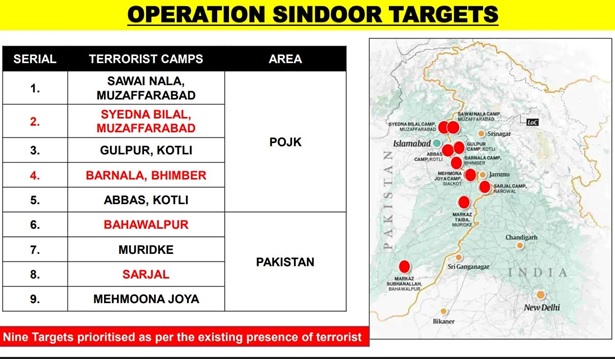
(Image source: MEA &MoD media briefings,https://www.youtube.com/live/ZMNaummDlgE?si=r39FfTdEKPS-YYQT)
Table 1: List of Targeted Sites on the Noght of 06-07 by India
|
Serial Number |
Name of the terrorist site |
Organisation |
Used for |
|
01* |
Shawai Nalla camp, Muzaffarabad |
Lashkar-e-Taiba |
Infiltration points and training facilities for sleeper cells. |
|
02* |
Syedna Bilal camp, Muzaffarabad |
Jaish-e-Mohammed |
Infiltration points and training facilities for sleeper cells. |
|
03* |
Maskar Raheel Shahid, Kotli |
Hizbul Mujahideen |
Sniper, guerrilla warfare, surprise attacks |
|
04* |
Markaz Ahle Hadith, Barnala, Bhimbher |
Lashkar-e-Taiba |
Support facility and regional logistics hub |
|
05* |
Markaz Abbas, Kotli |
Jaish-e-Mohammed |
Suicide bombing training and weapons distribution |
|
06# |
Markaz Subhan Allah, Bahawalpur |
Jaish-e-Mohammed |
Ideological and operational headquarter |
|
07# |
Markaz Taiba, Muridke |
Lashkar-e-Taiba |
Pre-infiltration camp for newly recruited terrorists |
|
08* |
Sarjal, Tehra Kalan, Shakargarh tehsil of Narowal |
Jaish-e-Mohammed |
Indoctrination, logistics, and planning |
|
09* |
Mehmoona Joya, Sialkot |
Hizbul Mujahideen |
Training centre |
(Source: The author has collected data from various media reports.)
Note:-*: destroyed by the Indian Army;#: destroyed by the Indian Air Force. (Baatcheet, 2025, pp. 4-5)
These terrorist sites were targeted by the Indian Armed Forces. The Indian government claims to have targeted terror infrastructure rather than Pakistani civil and military facilities. According to PIB (2025), India's actions were non-escalatory, and any further escalation would be dealt with. More than 150 terrorists were slain overall. (Shankar, 2025) It reflected Pakistan's poor air defence capability and India's superior air power. The use of fire power by the IA is also witnessed in the operation as seven out of nine terror targets were destroyed by it. This implies the IA’s increasing quest for developing the long-range precision strike capabilities. The strikes in Tier-I also highlight that the IA and IAF has received the required jointness to execute such operations together and the appointment of the CDS has certainly facilitated it.
Tier-II: Pakistan’s response (night of 07-08 May 2025)
As anticipated, Pakistan targeted a variety of military and civilian targets along the Line of Control and the international border using fighter aircraft, drones, and missiles. In air, they were rendered ineffective by India's Air Defence and Integrated Counter Unmanned Aerial System Grid. (PIB, 2025) It reflected Pakistan's poor reflexes on air power and India's effectiveness in air defence. However, India had warned that any response from Pakistan would be unacceptable. Thus, the situation was bound to worsen.
Tier-III: India responded back (morning of 08th May 2025)
In response to Pakistani attack, India targeted AD infrastructure, including destroying radar in Lahore. (PIB, 2025) India's equipment proved lethal because Pakistan's Chinese-made HQ-9 and HQ-16 AD systems failed to intercept the majority of it. The failure of Pakistani military systems led to a sense of inadequacy among military commanders and civilians. Moreover, the use of OSINT, media, and social media has increased battlefield transparency for both commanders and the public. It also caused a lot of disinformation and misinformation among people.
Tier-IV: Pakistan (night of 08-09 May 2025)
Pakistan’s escalatory steps after India’s retaliation were as expected. About 400 UAVs and drones were launched in a massive attack at 36 locations across India, but they were intercepted. Along with intense artillery shelling, there were also dogfights between the air forces. Throughout the operation, this phenomenon is consistent.
Tier-V: India retaliated (on 09th May 2025)
In retaliation, India destroyed Pakistan’s AD radar and attacked Pakistan's four AD sites with UAVs and kamikaze drones. Aerial vehicles and artillery were also heavily utilised.
Tier-VI: Pakistan’s ‘Operation Bunyan-al-Marsus’ (night of 09-10 May 2025)
After India's response, Pakistan launched Operation Bunyan-al-Marsus at the strategic level, using all available means to demonstrate its air power. It used Chinese-origin PL-15 missiles (PIB, 2025) and Turkish-origin Yiha in fighter jets, Chinese JF-17s, and American F-16s to attack 26 Indian locations, including important Indian Air Force stations at Udhampur, Pathankot, Adampur, and Bhuj. The majority of missiles, UAVs, and drones were successfully intercepted by India's sophisticated defence systems. (PIB, 2025)
Tier-VII: India’s massive hits on Pakistan (night and morning of 09-10 May 2025)
Following Operation Bunyan-al-Marsus, India targeted Pakistan's air force establishments, including eight air bases and three radar sites, as shown in the figure and table below. It was an extended step India took because the targets were the main military hubs, which paralysed the further use of air power by Pakistan, and it convinced the Pakistani military to seek a ceasefire. The majority of the runways, radars, and hangars were destroyed in this attack and were no longer operationally viable.
Fig 2: Pakistani air bases and radar sites attacked by India in Tier-VII
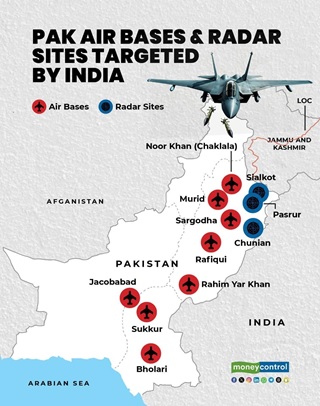
(Image source:https://images.moneycontrol.com/static-mcnews/2025/05/20250512083254_Pak-air.jpeg
Table 2: Sites and Assets Targeted
|
Serial Number |
Name of the military site |
Uses and assets |
|---|---|---|
|
01 |
Noor Khan Air Base, Chaklala (Northern Air Command and Control network) |
Air refuelling, transportation, overseas and protect nuclear arsenals, Lockheed C-130 Hercules, Ilyushin Il-78 refuelers, and Karakoram-8 |
|
02 |
Murid Air Base, Chakwal |
UAVs like Chinese Chengdu Wing Loong II, and the Turkish Bayraktar TB2 |
|
03 |
Mushaf Air Base, Sargodha |
Chengdu J-7, French Mirage 5, JF-17 Thunder, F-16 Fighting Falcon |
|
04 |
Rafiqui Air Base, Shorkot |
JF-17s, Mirage 5s, and Alouette III utility helicopters |
|
05 |
Rahim Yar Khan Air Base |
Providing runway facilities |
|
06 |
Shahbaz Air Base, Jacobabad |
JF-17 Block II, F-16 Fighting Falcon, and Leonardo AW139 |
|
07 |
Sukkur Air Base |
Providing air connectivity, sheltering aircrafts |
|
08 |
Bholari Air Base, Jamshoro |
JF-17 Thunder and F-16 Fighting Falcon jets, and Saab 2000 AEW&C aircraft |
|
09 |
Sialkot Radar Site |
surveillance |
|
10 |
Pasur Radar Site |
surveillance |
|
11 |
Chunian Radar Site |
surveillance |
The infrastructure of the air bases, including runways, hangars, and command and control centers, was destroyed after India's attack on May 10th. The use of BrahMos cruise missiles in Sukhoi-30 MKI, along with loitering munitions; Harop and SkySkriker, to attack these sites was crucial, extremely precise, and unstoppable by Pakistani AD systems, including its radars. In addition, India targeted Pakistan's fighter fleet, airborne warning systems, transport fleet, and other air power assets. One SAAB-2000 AWACS, which was 315 kilometers inside, was shot down by an S-400, which was activated 11 times during this operation. Other losses included a C-130J, a JF-17, two F-16s, both on the ground and in the air, an LY-80 AD system in Lahore that used a HARPY kamikaze drone, and an HQ-9 AD system (a Chinese version of the S-300) in Malir, Karachi. (Gupta, 2025) Pakistan suffered significant harm when its most advanced air power tools, both offensive and defensive, were ineffective.
The deadly and decisive Indian response in Tier-VII was so severe that it forced Pakistan to communicate with its Indian counterparts and demand an immediate ceasefire.
Tier-VIII: Ceasefire request from Pakistan (on 10th May 2025 at 1535 hrs)
At 1535 hours, the Director General of Military Operations of the Pakistani Army spoke with his Indian counterpart in an attempt to reach a ceasefire following India's devastating attacks in Pakistan. India remained committed to preventing more conflict and agreed to a ceasefire with Pakistan beginning at 1700 hours on May 10, 2025. At this point, India paused Operation Sindoor and warned Pakistan not to escalate the situation further. In the public domain, however, the ceasefire announcement came from US President Donald Trump's X handle. But until midnight, reports of drones, unmanned aerial vehicles, and artillery shelling in the J&K and Punjab sectors prompted India to take appropriate action. No escalation reports were made after that.
Strategic gaps in Pakistan’s Air Power
Despite their claims that India was planning to attack Pakistan, they were unable to adequately prepare for the attack because it was widely expected that India would strike back. However, they had moved their fighter planes from the LoC and the IB to the Durand Line along the Afghan border to shield themselves from India's retaliation after Pahalgam.
From Tier I to VIII of Operation Sindoor, Pakistan's air power—including its capacity to employ assets for both offensive and defensive purposes—has demonstrated a great deal of incompetence. When the IA and the IAF launched this operation to target nine different terrorist sites in Pakistan and POJK, it "bypassed and jammed Pakistan's Chinese-supplied air defence systems, completing the mission in just 23 minutes, demonstrating India's technological edge." (PIB, 2025) This assertion emphasises how India's Suppression of Enemy Air Defence (SEAD) capabilities, which are based on EW, are superior to Pakistan's. Indirect combat eventually evolved into direct combat between the two forces.
On May 7, the MEA and the MoD jointly briefed the public on the real-time footage, which was recorded by cameras on Harop and SkyStriker drones. It draws attention to Pakistan's air defence systems' flaws, which India was unable to fix by jamming them with electronic warfare. Since these locations do not fall under the VA or VP categories, many would contend that they were not provided with adequate air defence cover.
Fig 3: The overall attacked sites, including terrorist and military infrastructure in Pakistan and POJK from Tier I to VII
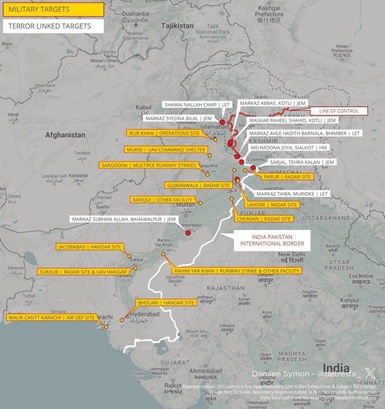
(Image Source: https://x.com/detresfa_/status/1921824104459522054?t=0_Z_4MtbenQ7ntqH256uug&s=19 )
But when we look at Tier-III, Tier-V, and Tier-VII (as discussed above), this argument breaks down. India's Destruction of Enemy Air Defence (DEAD) doctrine now only targets military installations after destroying Pakistan's two radar sites and nine major air bases, which were vital components of their air power. Radars intended to detect enemy movements were the first targets, followed by attacks on air bases and other military installations. Pakistan's incapacity to defeat them has raised questions about its air defence capabilities as well as its over-reliance on Chinese military hardware. Pakistan also needs to make up for the heavy losses it suffered during this operation to its fighter and transport fleet, especially the downing of an AE&WS 315 kilometers inside Pakistan by an S-400 anti-aircraft missile fired from inside India. Pakistan's inability to repel India's SEAD and DEAD attacks and its frequent defensive air power losses make this evident.
In terms of offensive air power, which includes the capability of striking India with fighter aircraft, drones, UAVs, missiles, and other weapons, Pakistan has now failed miserably. It was observed that the majority of the kinetic actions by Tier-II, Tier-IV, Tier-VI, and Tier-VII Pakistan were unable to reach the targets and were left indecisive. India successfully intercepted the PL-15, Yiha drones, and Fateh-II missiles. China is generally unconcerned with its reputation as a defence exporter because it has few regional partners, such as Bangladesh, Myanmar, and Pakistan, that cannot produce their own weapons, cannot afford to purchase sophisticated Russian or American weapons, and may not even need them depending on the threat perception.
India’s use of indigenous equipment and systems
Over the past two decades, India has been working to become self-sufficient in defence software and hardware, but it hasn't had access to the standard operational tests that Operation Sindoorprovides. India has used a lot of its military hardware and software for the C4ISR, including the AI-integrated Akashteer, the upgraded and integrated vintage L-70, the SkyStriker kamikaze drones, ISRO's space power, and Akash to BrahMos. For the first time in its history, India has avoided relying on the unreliable Western Global Positioning System and instead used its own indigenously developed Command, Control, Communications, Computers, Intelligence, Surveillance, and Reconnaissance (C4ISR) capabilities in a real-time operational environment. C4ISR capabilities play a critical role in modern military operations. Every major power, including the US, Europe, Russia, and China, has its own satellite navigation system.
The intersection of the ‘Space Power’ and the ‘Air Power’ in military operations
As Dr. V. Narayanan, the chairman of the Indian Space Research Organisation (ISRO), said on May 11, "at least ten satellites are continuously working round the clock for strategic purposes—to ensure the safety and security of the citizens of the country" (Narayanan, 2025).
With the aid of ISRO’s space power through satellites, the Indian Armed Forces could create the winning situation in Operation Sindoor. These satellites are essential for precise navigation, secure communications, and real-time intelligence. (Siddiqui, 2025) These resources have provided assistance to this operation prior to, during, and following the operation. During the pre-operation stage, the Indian Armed Forces needed satellite imagery to identify and prioritise key terrorist locations. The subsequent one found underground bunkers, hardened shelters, and valuable air assets. It provided India with C4ISR capabilities to gain real-time situational awareness of the enemy and allies at the strategic, operational, and tactical levels of the execution. Following the operation, these satellites helped the Armed Forces assess the strike's impact and the extent of the damage. The images were made public as evidence of the damage following preliminary analysis at headquarters.
Table 3: Tools used in Targeting
|
Serial Number |
Name of the asset |
Classified use |
Practical uses |
|---|---|---|---|
|
01 |
Cartosat Series |
Optical imagery |
Target identification and post-strike damage assessment |
|
02 |
RISAT Series |
Day-and-night radar imagery |
Detecting enemy movement and infrastructure |
|
03 |
GSAT-7 / GSAT-7A |
Communications |
Secured and real-time communications |
|
04 |
NavIC |
Supporting navigation |
high-precision geo-location data to guide missiles, aircraft, and drones with pinpoint accuracy |
NavIC
The Navigation with Indian Constellation, a regional navigation satellite system operated by India, provides the Indian Armed Forces with cutting-edge C4ISR capabilities and covers the whole South Asia. For both offensive and defensive applications, they are critical to the functioning of all land, naval, and air power systems, such as radars, imaging systems, signals, navigation systems, and more. The Indian Armed Forces gained an advantage over Pakistan in Operation Sindoor, thanks to NavIC, which provided high-precision geolocation data to precisely guide drones, aircraft, and missiles while the entire operation was still conducted using air power components.
In the Tier I attack, for example, India used kamikaze drones, and fighter aircraft launched bombers and cruise missiles, which needed continuous guidance and monitoring. In addition, the use of air power increased significantly in the next tiers as India attacked Pakistan's key military installations. None of these tasks could be assured without NavIC.
Fig 4: Picture representing the operations of the NavIC (from space to ground)
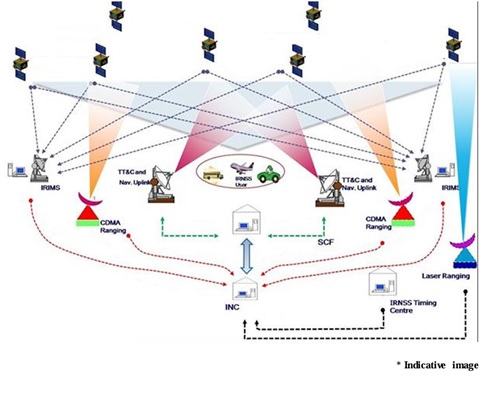
(Image Source: https://www.isro.gov.in/media_isro/pdf/SateliteNavigation/NavIC_SPS_ICD_L1_final.pdf )
Integrated Air Command and Control System (IACCS)
IACCS is a national-level command and control system of the Indian Air Force, which played a key role in Operation Sindoor. As previously mentioned, the operation served as a demonstration of both sides' air power. Therefore, controlling and coordinating these actions is Air C2's primary responsibility. IACCS helps commanders keep an eye on the situation in real time by providing a "Recognised Air Situation Picture." It incorporates inputs from the three services' air power mechanisms that are spread throughout India, particularly Akashteer, which did a fantastic job fending off Pakistani air strikes.
As an AI-integrated force multiplier in Operation Sindoor, the IACCS first identified and tracked air threats, then allocated air defence systems based on their ability to intercept targets, and finally gave commanders real-time situational awareness. It served as the country's single-point air command and control system, saved time, gave the big picture, and prevented confusion or chaos among the stakeholders, giving an overall clarity of the situation. India's success in Operation Sindoor can be attributed to IACCS. However, IACCS is still uneasy about rerouting or altering the missile's target while it is in the air, (Pandey, 2025) and it will likely take another ten years.
SkyStriker Kamikaze drones
Kamikaze drones have been used in active operations for the first time in India's or, perhaps more accurately, South Asia's history; their application has altered the strategic calculations of war between the two countries. Together with Harop, they were instrumental in Tier-I, which targeted the terrorist infrastructure during Operation Sindoor. (NDTV, 2025) They were further employed in a series of attacks on military installations in Pakistan. They are thus "battle-proven" assets of the Indian military.
BrahMos cruise missile
India's armed forces now have the BrahMos cruise missile, which was developed in collaboration with Russia. India used Sukhoi-30 fighter jets fitted with BrahMos to strike targets inside Pakistan during Operation Sindoor. The JeM camp was also struck by BrahMos, as evidenced by the debris discovered in Bikaner. (Sharma, 2025) A total of 15 BrahMos missiles were fired on May 10 to strike Pakistan's 12 air bases and radar stations. (TOI, 2025) It is an unmatchable cruise missile, and it had earlier proved its credibility when a misfire from Sirsa caused it to fall in Pakistan without being intercepted by their systems. It demonstrates Pakistan's inability to stop BrahMos up to this point. However, experts claim that no AD system can intercept it, not just in China or Pakistan. In an interview with CNN-18, its former DG, Sudhir Mishra, stated:
“The Brahmos is a supersonic missile. It cannot be intercepted by the air defence systems of Pakistan and China. It cannot be intercepted by any known Defence system in the world." (Mallick, 2025)
It is unlikely that Pakistan will be able to counter India's BrahMos missile for many decades to come. India gains strategic leverage over Pakistan as a result.
Akashteer Air Defence System
It is an entirely domestically developed automated ‘Air Defence Control and Reporting System’ and is likely the only AD system that integrates air defence guns, radars, and a control room.
“It doesn’t just see faster—it decides faster, and it strikes faster than anything fielded globally.” (PIB, 2025)
It operated as a subset in tandem with IACCS and was stationed in the forward regions by the Indian Army. During this operation, it effectively intercepted every kind of aerial threat Pakistan posed. During the operation, which was coordinated with satellites, NavIC, and IACCS, India benefited from the fact that Akashteer avoided friendly fire and supported C4ISR capabilities while integrating with systems both larger and smaller than it. Its implementation continued to revolutionise the production of the best outcomes.
Akash Air Defence System
It is an indigenously developed surface-to-air missile system designed to counter any sort of aerial threats like fighter jets, drones, UCAVs, UAVs, cruise missiles, and air-to-surface missiles. During Operation Sindoor, this system proved its credibility as it neutralised the drone and missile attacks from the adversary with a high success rate, including the Fateh II. (India Today, 2025)
D4 counter-drone system
It is a domestically created "Drone-Detect, Deter, and Destroy system" that can destroy any type of drone or unmanned aerial vehicle using spoofing, jamming, and laser-based killing techniques. (TOI Desk, 2025) This system, which is highly capable of hard-killing using laser-based directed energy systems and soft-killing using jamming and spoofing, was used to counter Pakistani drone and unmanned aerial vehicle attacks.
Upgraded legacy Air Defence Systems
An important advancement in India's air defence management has been the use of all the Indian Armed Forces' legacy AD systems, such as the L-70, Pechora, OSA-AK, and LLAD guns, to counter Pakistan's aerial attacks. (PIB, 2025) Their prior battle experience and ability to shoot down various drones and UAVs increased their significance in this operation. These systems have been modified and put to use in accordance with AD regulations in India. However, if China had been an adversary, India would not have achieved the same or comparable outcomes.
Increase in Information Warfare (IW)
Information warfare, also known as psychological warfare or operations (PsyOps), has become increasingly prevalent in the twenty-first century. It uses information to exploit the enemy's weaknesses in order to demoralise the adversary. Although it has been in use since the ancient Mahabharata, it was used to demoralise Dronacharya in the name of his son's death after an elephant named Ashwathama was killed. In a similar vein, many Ashwathamas were said to have been killed in this conflict, but they weren't. There were PsyOps about the removal of Indian defence personnel from their posts, the destruction of the S-400, the downing of three Rafales, the nuclear leak in Pakistan, and the destruction of Indian military infrastructure.
During Operation Sindoor, both sides carried out these PsyOps. One of the manipulated documents that went viral on social media following the Pahalgam attack was titled "Assessment on Op Readiness" and was created by the Directorate of the HQ IDS. Four issues—military gaps, low force morale, the vulnerability of vital civil infrastructure, and the absence of Atmanirbharta, or reliance on foreign hardware—were emphasised in that letter. However, these have turned out to be the Indian forces' true strengths following this operation.
The growth of OSINT has led to more delusions in the name of intelligence as well as greater battlefield transparency. As a result, political organisations, military leaders, and all parties involved faced significant difficulties. It is very regrettable that our own people, in the name of romanticism, become eyes and ears for the enemy and a disadvantage to our own forces, as the surprise is often lost. The majority of civilians have smartphones and internet access, and whenever there is a military movement; videos are recorded and shared on social media that reach the opponent. The adversary might also seize the chance to mislead the public. Every one of these was seen during Operation Sindoor. Social media and television media both acted horribly in Pakistan and India. During this conflict, a great deal of unverified (mis)information was disseminated in an attempt to generate publicity and stir up unrest among the populace. It put additional pressure on the governments to eliminate the misinformation and conduct regular fact-checks. The Ministry of Defence and the Ministry of External Affairs also regularly held joint briefings to discuss the status of Operation Sindoor. Fifteen per cent of the IA's time was spent fighting the spread of false information during this operation; (Singh, 2025) this placed a significant strain on the forces' capabilities.
Speculations over nuclear hit
Major General Rajiv Narayanan, a senior retired Indian Army officer, stated in a YouTube interview on "PGurus" that "nuclear assets have been neutralised completely, I won't say completely, all the warheads which they had kept in these two hill features are gone." (PGurus, 2025) This is one of many expert and media assessments regarding the nuclear facilities that India struck at Kirana (near Sargoda) and Changai (near Jacobabad) Hills. Another one, Mr. Derek Grossman, a former CIA officer who is currently an analyst with the RAND Corporation, claimed that a radioactive leak occurred following India's attack on the Nur Khan airbase. As evidenced by an American Department of Energy plane (B350) that carried out an aerial nuclear radiation reconnaissance in those areas early on May 10th. In the past, this aircraft was utilised in Fukushima. (ET Online, 2025)
Meanwhile, in response to questions from media, the Director General of Air Operations (DGAO) said that he was not aware of its nuclear weapons storage facility and denied the hit on Kirana Hill, but a released video by the IAF (on Operation Sindoor) on the Republic Day 2026 tells a different story. The Kirana hit is officially shown in that video, but the IAF has maintained the anonymity over any vocal acceptance. (Singh, 2026)
Furthermore, both India and Pakistan have signed the Non-Attack Agreement (NAA) on each other's nuclear facilities, whether they are military or civilian. The DGAO's admission that he was not aware of Kirana's nuclear storage suggests that India was not informed of this fact during the yearly bilateral nuclear site exchange on 1 January 2025. Since there is no nuclear facility in there according to NAA records, India knows that Pakistan will never acknowledge that its nuclear facilities have been targeted, so this confirmation of leakage may never come from a primary source. Later, on May 15, the International Atomic Energy Agency declared in a statement that Pakistan was not experiencing any radiation leaks. (ET Online, 2025)
India may have considered doing it to inform Pakistan that everything is fine in war whether they are nuclear warheads, and the strike did not hit so hard that it could cause leakage, or it was the calculated use of force to put an end to the conflict.
Doctrinal change during Operation Sindoor
The Government of India (GoI) has strengthened its defences against future terrorist attacks. The GoI has reoriented its counterterrorism doctrine by defining an act of terror as an act of war. Given that India has long struggled with terrorism and that the NDA government has consistently taken action to punish those responsible, whether it was following Uri, Pulwama, or the most recent, Pahalgam, it is significant from both countries' strategic perspectives. However, going forward, India is probably going to react against Hamas in a manner similar to what Israel did in Palestine and broaden the scope of its response to include other supporting groups like Iran-sponsored Hizbullah, Hoithi, etc. In the Israel-Hamas conflict, Israel has responded more forcefully than anticipated to exact revenge for Hamas' murders and hostage-takings, regardless of the innocent civilians killed in Gaza. However, India, being a responsible and mature nation, will not take such action. Instead, a heavy, calibrated force is likely to target the terrorists' supporters, such as the ISI and the Pakistani Army, as part of the punishment for the terrorists.
Is Nuclear threat irrelevant?
Following the CT doctrine change, India has made it clear that it will use conventional means to achieve its goals, including bringing the state to the battlefield in the event of a state-sponsored terrorist attack, rendering Pakistan's regular nuclear threat moot. When terrorist attacks occur, Pakistan continues to use its nuclear card to evade India's traditional response. The message of Operation Sindoor was that if someone attempted to jeopardise India's national security, the appropriate action would be taken. Some have also argued that it was the final Indian response to terrorism of this kind. Prompt reactions, such as war, would be more deadly and decisive. Furthermore, it is much more practical because the Indian Armed Forces came up with the idea of threat perception management this time around and held war gaming on April 26th, 27th, and 28th, where AD personnel practiced and simulated these drone threats in nearby areas. (D'Cunha, 2025) Similar to this, all branches and services of the Indian Armed Forces participated in additional simulations. These were classified but undoubtedly existed, and striking Kirana and Chagai Hills was not an error in judgment. The recent Russia-Ukraine war saw instances of attacking the adversary's nuclear weapons. Similar assessments were made in this operation, where India eliminated the nuclear threat that resulted from PM Modi's remarks following Operation Sindoor. The only alternative is to activate the battlefield, so this doctrinal shift has greatly deterred Pakistan from committing any misfortune against India.
Strategic lessons for India and Pakistan
Both India and Pakistan, the adversaries, have received strategic messages from this operation. India, which had to deal with a massacre like Pahalgam, took kinetic and non-kinetic action against those responsible and then protected its military and civilian infrastructure from Pakistani attacks. Due to its alignment with US interests against the USSR, Pakistan had previously legalised terrorism sponsorship; however, after Operation Taupac, it shifted its focus to India. Pakistan can learn a great deal from this war. The primary topics of both lessons are politics and security.
Lessons for India
India has been severely harmed by Pakistan's use of terrorism as a weapon in its proxy war strategy. By adjusting and implementing its counterterrorism doctrine, India has been making constant efforts to eradicate this. Due primarily to the intelligence failure, the Pahalgam attack on tourists has rocked Delhi's political and security establishments. Indian political and security establishments have learned important lessons from Pahalgam and Operation Sindoor, which are covered below:
Reducing intelligence gaps
Security agencies were taken aback by the Pahalgam attack since there was no prior intelligence about it, if had no appropriate action was done. It was a serious assault by terrorists that claimed the lives of 26 tourists. Security experts are aware that such attacks necessitate meticulous preparation, which includes giving terrorists advance training to help them comprehend the purpose of the attack, making sure they enter the Indian side without being harmed, and giving them the required local support, stress-reduction strategies, navigation drills, the kinds of equipment and logistics offered, etc. Additionally, there was a possibility that information would be leaked during the planning and execution of this attack, either purposefully or accidentally, by Pakistani agents and J&K residents (human intelligence, or HUMINT) or inadvertently through technical intelligence (TECHINT) monitoring and analysing cyber activity, but it did not happen. The unfortunate attack on tourists at Pahalgam resulted from this failure. Another example is the lack of boots on the ground, or troop deployment, which was also evident during a string of attacks in the peaceful Jammu region in the past. The subsequent troop pullout also provides terrorist attack planners with a chance to target less secure areas where India was perceived as posing little threat. In addition, boots on the ground collect intelligence, interact with locals, and prevent most attacks from occurring.
China’s support to Pakistan
China's support for Pakistan is unwavering, as demonstrated by Operation Sindoor. China has stood with Pakistan in this conflict since it first provided diplomatic support for Pakistan in the UN on issues of terrorism and Kashmir. When Pakistan indulged India, China was actually fighting in the form of military hardware and software. China supplied the air power equipment used against India, including J-10s, JF-17s, HQ-9s, HQ-16s, PL-15s, and other satellite-based ISR aid. Furthermore, the terrorists who carried out the Pahalgam massacre were using satellite-enabled smartphones made by Huawei, a Chinese company, for navigation and communication. Additionally, it was the first time in history that indigenous Chinese and Indian weapons were actually used in combat. On behalf of China, Pakistan has also tested India's air power capabilities; if not, it has at least provided China with an evaluation of the Indian Armed Forces' capabilities. India should remain focused on keeping up its pace in order to develop its capabilities against China, its top adversary. India must also remember that China will always be there to support Pakistan.
Lack of Integration/Interoperability of various military equipment
India operates a variety of military equipment of all kinds imported from many countries, like Russia, the USA, France, Israel, etc. These may hold active and passive role. Taking Operation Sindoor and Operation Bandar together as examples, India used fighter jets like French Rafale and Mirage-2000; Russia Su-30 MKI and MiG-29; British Jaguar, etc., and AD systems like Russian S-400, and drones like Israeli Harop and SkyStriker, and lastly missiles/bombs like Indo-Russian BrahMos, French HAMMER and SCALP, and Israeli SPICE, etc. This presents a picture of India’s multiple sources for defence imports which lead to lack of interoperability. (Azad, 2025) This weak integration of military equipment creates gaps and decreases operational effectiveness. It suggests that no doubt integration is important in C2 structures for a better operational effectiveness, (Kumar, 2025) but the integration of equipment is equally important to really achieve that. Therefore, India must find some ways out to deal with it and aim for complete indigenisation.
Still far away from achieving full indigenisation
India continues to be the world's second-largest importer of weapons, accounting for 8.3 per cent of global imports, (Gupta, 2025) with 36 per cent coming from Russia, according to the Stockholm International Peace Research Institute. India has also relied heavily on foreign equipment in Operation Sindoor, including Russian Sukhoi-30 MKI and S-400; French Rafale, HAMMER, and SCALP; Israeli Harop suicide drones for targeting enemy positions. In addition to them, Israel and Russia collaborated with India to develop SkyStriker and BrahMos. Regardless of whether the targets were military personnel or terrorists, these were utilised frequently in this operation. The issue is that the opponent was relatively weak this time; the country cannot be secure unless it achieves a high level of self-reliance in defence. Due to limited or ‘mother control’ over the manufacturer, foreign weapons have both direct and indirect vulnerabilities. For example, India has been requesting the Rafale's source code from France in order to incorporate its own weapons and systems into it, but they are hesitant to share it and most likely will not.
Some crucial initiatives, such as the development of domestic fighter jets like Tejas and AMCA, are not proceeding as expected. The supply of American GE 404 and 414 engines, which is halted, is essential to the production of LCA Tejas. The AMCA may not be seen until 2035. Additionally, despite efforts since the 1990s for Kaveri, India has not been able to produce its own jet engine to date. India's air power, both offensive and defensive, is severely limited as a result of these factors, and it continues to rely on outside sources. Next is India's armored might. The IA primarily operates squadrons of T-72 and T-90 Main Battle Tanks of Russian origin, and the ongoing conflict between Russia and Ukraine has taught us that, despite Ukraine's inferiority, the country was able to destroy its advanced tanks with the aid of drones and unmanned aerial vehicles supplied by the West. India should learn from this because of its greater reliance on Russian equipment.
Apart from the previously mentioned, India needs to accelerate its indigenisation by completing Project Kusha and developing desi S-400-type capabilities for India, considering the high cost of the Russian S-400. There are also ongoing discussions regarding a third aircraft carrier and air-independent propulsion submarines, and efforts are underway to develop submarines as part of naval capabilities like Project 75I. Therefore, India must monitor the difficulties in all three services. In general, India must put in a lot of effort because China is also willing to checkmate, so Pakistan is not alone.
New doctrine against terrorism: is it really a new normal?
Since Pakistan does not even have the ability to control terrorism, India is prepared for action. With a crackdown on the infrastructure supporting terrorism, no establishment in Pakistan can endure. The question still stands as to how long this operation will continue to deter Pakistan from launching a significant terrorist attack against India. It is untrue to say that Pahalgam is the only terrorist attack following Pulwama; however, it is the only significant terrorist attack following Pulwama. Small-to-medium-sized terrorist attacks occur in India every year. For example, on June 9th last year, in Reasi, nine people—including seven Hindu pilgrims—were killed and forty-one injured. But unlike Operation Sindoor, there was no Indian reprisal. LeT carried out this attack, and this year in Pakistan, an unidentified shooter killed its mastermind, Zia-ur-Rehman. In addition, he participated in the terror attacks against the IA in Kandi and Bhatta-Durian in India. (PTI, 2025) India did not directly respond to Pakistan in these attacks; instead, operations were restricted to removing terrorists in J&K using additional forces.
This demonstrates that only in the event that Pakistan launches a significant terrorist attack against India will India's policy of equating an act of terror with an act of terror become operational. In other words, if there are any more terror attacks like Uri, Pulwama, or Pahalgam, India will go to war. However, this is unlikely for small-scale attacks. Since Pakistan will not launch a large-scale attack but will continue to deliver small to medium-sized cuts on a regular basis, India is equating its counter-reaction to the number of people killed, which is incorrect. India should make it clear that the doctrine will treat terror attacks as acts of war regardless of their size.
Ensuring diplomatic isolation of Pakistan
Shortly after the temporary ceasefire, India used its diplomatic influence to target Pakistan as part of a "global outreach program" aimed at fostering international unity against terrorism and its causes. All political parties are working together to expose Pakistan's support of terrorism and its use against India. It has also revealed how IMF funds are being used to support terrorism rather than the nation's progress. By drawing attention to Pakistan's involvement in Pahalgam, earlier terrorist attacks on India and other countries, particularly 9/11, and—above all—its provision of sanctuary to Osama Bin Laden, the Western powers' hypocrisy is exposed, and their suffering is sympathised with. The world's focus has also been drawn to Pakistan's safe-haven policy for terrorists, and this campaign has made room for only India's self-defence against terrorism. Indian delegations are examining Pakistan's safe use of IMF aid and laying the groundwork for Pakistan's re-entry into the Financial Action Task Force's "grey list." The immediate effect of it is that the government of Cambodia has shifted its position in favor of India.
Jointness among the Tri-Services
India has lagged behind in the process of integrating all three services since the establishment of the Department of Military Affairs and the appointment of the CDS. This is because the position was established on January 1, 2020, with the appointment of General Bipin Rawat. But for nine months following his death, it was empty. In a nutshell, Operation Sindoor made it abundantly evident that India has been working to make its armed forces more cohesive and integrated. Sitting together in the war room, the CDS and all three service chiefs had planned, directed, and carried out the operation. As previously mentioned, during the Tier-I examination, the IA and IAF used their respective air power assets to jointly launch attacks on terrorist sites in Pakistan and the POJK. More significantly, the IAF and IA assets coordinated by IACCS and its subset Akashteer, respectively, facilitated C4ISR when Pakistan launched a series of attacks in Tier-II, IV, VII, and VIII. The systems of both services eliminated the area threats, with the IAF concentrating on the Indian heartland and the IA on the frontier areas. This demonstrates how India exemplifies comprehensive air power, with all three services integrated and overseen by the CDS. Yet, the integrated threatre commands are the only way out for achieving the desired jointness and must be achieved timely.
Furthermore, as the CDS pointed out in the Shangri-La Dialogue, future conflicts will be fought in drone warfare, EW, and unmanned teaming aerial platforms, necessitating the creation of a specialised tri-services organisation. (Singh, 2025) India needs to prepare and complete its integrated theater command reforms and assimilate these necessary changes since China has proactively raised its standards in this area.
A "Tactical Error" in Tier-I caused aircraft losses
Although the exact numbers of the IAF's losses in Operation Sindoor have not yet been made public, there were conjectures among experts and the general public. However, in an interview with a foreign network on May 31, the CDS admitted that India made a "tactical mistake" on the night of May 6–7 (Tier-I), resulting in the loss of IAF fighter jets, though the exact number has not yet been disclosed. He continued by saying that the error was acknowledged and corrected. Those two days later, India once more precisely targeted Pakistan from a great distance (referring to Tier-VII hits). The issue of grounding entire fighter fleets of the IAF for consecutively two days (while being in war) is very alarming. It questions the severity of the mistake, which is termed as “tactical”, but could have resulted in devastating strategic implications.
This may have been caused by the IAF's frequent use of fighter jets, which, like the 2019 Balakot airstrike (Operation Bandar), left Pakistan less surprised. Also, bringing the IAF’s jets close to borders might have allowed the Pakistani side to intercept and engage them when they were trying to hit the terror infrastructure (as this strategy had been already used in 2019, it might have given resulted in less-surprising for Pakistan as they were likely to have developed such counter-capabilities and ambush Indian jets if there is a repetition). The official answer to the "tactical mistake" is still unknown, but India could have avoided using these jets or firing from far distance (away from Pakistan’s range).
India’s growing weapon industry
The export of weapons is a very lucrative industry worldwide, and all of the major powers are the biggest exporters of defence products. India should take advantage of this opportunity since it has tested and demonstrated its domestic air power equipment, including air defence systems, missiles, and loitering munitions, for the first time. These include D4, BrahMos, Akashteer, Akash, and SkyStriker. Since the world has closely observed these systems and they have yielded positive results, India is anticipating orders from friendly nations, as it has previously exported or is currently exporting such systems. However, India must exercise caution because it is new to the field, and there are instances where the US has purchased Russian equipment from a third party in order to investigate and study its vulnerabilities. India has a great opportunity to export these systems, so it must act quickly and carefully.
These were the strategic lessons that India could learn from bridging intelligence gaps to prevent future attacks that could force India into combat; China's use of Pakistan as a proxy to challenge India; India's lack of indigenisation and the limited ballistics provided to its export industry during this operation; the change in India's counterterrorism doctrine that will undoubtedly force India to confront Pakistan on the battlefield; India's strict action plan to tighten Pakistan's nuts and bolts through the use of diplomacy on the international arena; India's efforts to foster unity among the armed forces during this operation; and finally, as information continues to surface, the CDS has admitted the ‘tactical mistake’ during Operation Sindoor that resulted in the losses.
Lessons for Pakistan
A must to put end on State-sponsored terrorism
Given the shift in India's counterterrorism doctrine, any act of terrorism will result in a conflict between India and Pakistan. The practice of Pakistan siding with terrorists was first made public when India attacked the terrorists' locations and Pakistan decided to defend them. The very next day, they were seen at the terrorists' funerals and retaliated by attacking India's military and civilian infrastructure. It shed light on Pakistan's use and defence of terrorism as well as India's counterterrorism strategy. The fact that Pakistan itself launched an aerial attack on Iran after a terror attack is highly contradictory.
Foreign dependency for military equipments
Pakistan ought to reevaluate its dependence on Chinese and Turkish military hardware. To survive, it must either develop its own weaponry industries or purchase top-notch weapons. Pakistan imports 81 per cent of its military equipment from China, and that is 63 per cent of total Chinese exports. (DSA, 2025) The performance of these Chinese devices was also put to the test during the recent Operation Sindoor. Pakistan's offensive weapons and fighter fleets, such as the JF-17, PL-15, and others, used hard kill capabilities, while the HQ-9 and HQ-16 AD systems were paralysed by its soft kill or electronic warfare capabilities.
Pakistan has suffered a strategic defeat in this operation, as the majority of its offensive and defensive capabilities have been ineffective. Instead of relying on erratic imports, Pakistan must expand its armaments industry. However, there are numerous challenges, including inadequate R&D capabilities, a weak economy, and—above all—power in the wrong hands. Pakistan needs to start over, but this won't be evident in the future unless there is a significant shift in the country's perspective.
A failed Air Power: Developing counter-SEAD and counter-DEAD capabilities
To thwart any air threat, Pakistan needs to strengthen its counter-SEAD and counter-DEAD capabilities, which were showcased during Operation Sindoor. The success or failure of a force can be ascribed to quantitative and qualitative, tangible and intangible factors. While the intangibles are solely qualitative and deal with training, discipline, leadership, motivation, and doctrine, the tangibles are the quantity and quality of its personnel, equipment, firepower, logistics, etc. (Singh, 2013, p. 27).
In both cases, Pakistan is inferior to India because their military still contributes more to their political objectives. It is commonly known that trying to manage multiple tasks causes one's focus to become less focused. India destroyed nine terror sites in Pakistan and POJK in Tier-I, and Pakistan's AD systems were jammed, leaving them without counter-EW mechanisms. India not only protected itself from Pakistani attacks in the future but also sent offensive shocks to Pakistan after destroying 11 important air power hubs and downing Pakistan's SAAB-2000 315 kilometers away with an S-400 missile. Pakistan has experienced significant losses and requested a ceasefire because of its inability to counter-SEAD and counter-DEAD operations, even though it has ascended this escalator ladder.
Addressing disruptions within
In addition to self-made rivalry with India, and its internal problems in Baluchistan, Sindh, and Khyber Pakhtunwa, Pakistan is currently under growing pressure from Afghanistan and Iran as well. Therefore, it should avoid any conflict with India, whether it is symmetrical through the military or asymmetrical through terrorism. Since doing so would cause Pakistan to suffer unbearable internal and external harm. Since the fighters in these three provinces are already well-trained and equipped, and fighting for their independence or seperation from Pakistan. These fighters recently hijacked a train that was carrying Pakistani military personnel. The attacks on Pakistani military personnel have increased in these provinces. Pakistan needs to resolve its internal problems, avoid confrontation with India at all costs, and proceed with utmost caution going forward.
Assure a capable and autonomous political class
In Pakistan, no elected government has served out its entire term. (Aljazeera, 2022) Although it is true that every country has an army, Pakistan's army has a nation, so the narrative needs to be changed. Success in politics cannot be achieved without the approval of the Pakistani Army. Pakistani political organisations should take advantage of the fact that India has revealed the true nature of the Pakistani Armed Forces in order to undermine the forces' power over the nation, but there are probably not going to be many opportunities in this area. This is the only long-term solution that seems feasible, and Pakistan has never been on the path to sustainable development.
Conclusion
India's counterterrorism strategy was reassessed during Operation Sindoor. This operation was driven by the combined action of the IA and IAF, employing air power on large-scale, high-value targets. Pakistan's larger response, which was less than that of India's earlier strikes, caused the situation to worsen. This article has examined Operation Sindoor and the strategic lessons two competitors learned. The key findings of the research are that India address intelligence gap through HUMINT and TECHINT to further robust its counterterrorism capabilities and also avoid any ‘tactical mistake,’ as in Tier-I, that led to losses and grounding entire fleet for two days. It must keep in mind that Pakistan will always have the support of China, with its ISR, military technology, and political influence on the global stage. India is facing issues with interoperability with its combo of military equipment; it needs to be improved for achieving operational effectiveness. India may have developed its own C4ISR capabilities through ISRO's satellites and NavIC systems, as well as equipment like Akashteer, Akash, BrahMos, and others, but it still has a long way to go before it can become self-reliant and unify its defence forces. The export of weapons must also be increased. India will continue to react normally to low-intensity attacks, but its change in CT doctrine will lead to war in the event of a major terror attack like Pahalgam, according to policy and diplomacy. Regarding diplomacy, India needs to tighten its grip on international platforms to isolate Pakistan.
Above all, if Pakistan continues to support terrorism as a state policy, India and the rest of the world will be powerless to prevent it from destroying Pakistan from within. During Operation Sindoor, Pakistan's air power has shown serious flaws, including offensive and defensive capabilities in terms of SEAD and DEAD. Pakistan's heavy reliance on imported machinery is one of the main reasons for this. The last but crucial issue is Pakistan's internal problems: its financial crisis, which makes it dependent on China, the IMF, and the Arab world; its military domination over the political class; and, lastly, the civil war-like conditions in Sindh, Khyber-Pakhtunkhwa, and Balochistan, which will ultimately make Pakistan incapable of surviving as a country. All things considered, for Pakistan to turn this situation around, it must undergo miraculous changes.
These findings reaffirm the relevance of limited war theory and deterrence-by-punishment in South Asia. Operation Sindoor demonstrated how political and strategic means can be achieved through limited and tier-based escalation without crossing the nuclear redlines. This conflict defines South Asia's strategic stability and has shown that conventional warfare between nuclear-armed nations is feasible. The IW has also grown to be a burden for both sides as OSINT, social media, and media sources have expanded.
References:
Al Jazeera (2022, April 9). ‘No Pakistani prime minister has competed a full term in office’. Al Jazeera. https://www.aljazeera.com/amp/news/2022/4/9/factbox-no-pakistani-prime-minister-has-completed-a-full-tenure
Azad, T. (2025, September 4). Technological Discord and Tactical Misjudgment: India’s Military Setback in the May 2025 Crisis. Opinion/Perspective. Small Wars Journal. https://smallwarsjournal.com/2025/09/04/technological-discord-and-tactical-misjudgment/
Baatcheet (2025, May). Operation Sindoor. Baatcheet Magazine. Additional Directorate General of Strategic Communication, IHQ of MoD (Army). pp. 4,5. https://indianarmy.nic.in/writereaddata/documents/BaatCheet/English/May%202025.pdf
Bhirani, G. (2025, May 13). Operation Sindoor: 8 Pakistani Air Force bases India wreaked havoc on with ‘precision strikes’. Mint. https://www.livemint.com/news/world/operation-sindoor-8-pakistani-air-force-bases-india-wreaked-havoc-on-with-precision-strikes/amp-11747108396931.html#amp_tf=From%20%251%24s&aoh=17472978183757&referrer=https%3A%2F%2Fwww.google.com
Business Today (2025, May 10). 'Snatching defeat from jaws of victory...': Brahma Chellaney questions India’s timing on Pakistan 'ceasefire'. Business Today. https://www.businesstoday.in/india/story/snatching-defeat-from-jaws-of-victory-brahma-chellaney-questions-indias-timing-on-pakistan-ceasefire-475799-2025-05-10
D’Cunha, Sumer Ivan (2025, May 21). Did you know India prepared for Pakistani drones with a simulation? Asian News International. [Video]. YouTube. https://youtube.com/shorts/2BjDdviuPko?si=q1C6ulzyrJtRdgoL
Defence Security Asia (2025, March 17). China Dominates Pakistan’s Arsenal: 81 Percent of Weapons Supplied over the Last Five Years. Defence Security Asia. https://defencesecurityasia.com/en/china-dominates-pakistans-arsenal-81-percent-of-weapons-supplied-over-the-last-five-years/
DD News (2025, May 8). Pakistan’s Defence Minister fails to justify claim of downing Indian jets. Doordarshan News. https://ddnews.gov.in/en/its-all-over-social-media-pakistan-defence-minister-fails-to-justify-claim-of-downing-indian-jets/
ET Online (2025, May 13). Nuclear leak whispers around Pakistan's Kirana Hills grow louder—But IAF dismisses claims. The Economic Times. https://m.economictimes.com/news/new-updates/nuclear-leak-whispers-around-pakistans-kirana-hills-grow-louder-but-iaf-dismisses-claims/articleshow/121140217.cms
Gupta, C. (2025, May 9). Top 10 largest arms importing countries (2020–2024): India’s position revealed. Indian Express. https://indianexpress.com/article/trending/top-10-listing/top-10-largest-arms-importing-countries-2020-2024-indias-position-revealed-9880245/
Gupta, S. (2025, May 24). Four air-launched missile strikes by IAF on May 10 and Pakistan was on the mat. Hindustan Times. https://www.hindustantimes.com/india-news/four-air-launched-missile-strikes-by-iaf-on-may-10-and-pakistan-was-on-mat-101748052752432-amp.html
India Today Science Desk (2025, May 13). How India's Akash missile hunts, locks, and destroys. India Today. https://www.indiatoday.in/science/story/how-indias-akash-missile-hunts-locks-and-destroys-operation-sindoor-2724102-2025-05-13
Joshi, V. (2025, May 07). Unidentified aircraft crashes in Punjab’s Bathinda, one farm labourer killed. Hindustan Times. https://www.hindustantimes.com/cities/chandigarh-news/unidentified-aircraft-crashes-in-punjab-s-bathinda-one-farm-labourer-killed-101746583826798.html
Kahn, H. (1965). On Escalation: Metaphors and Scenarios. New York: Praeger.
Kashyap, K. (2026, January 16). Op Sindoor Series, Ep - 4 | Vir Chakra Gallantry | Jab Tak Gun Na Toote... Fire Karte Raho!. Monks & Warriors by Kaushal & Kaushalendra (@monkswarriors). https://youtu.be/LIWndi6e67M?si=CtI3gjzH1FLWfnkh
Katoch, PC (2022). Indian Artillery Modernisation. SP’s Land Forces. https://www.spslandforces.com/story/?id=813
Kumar, M (2025, November 27). Fostering Joint Warfighting: India’s Joint Doctrine for Airborne and Heliborne Operations 2025. Issue Brief. ManoharParrikar Institute for Defence Studies and Analyses.https://www.researchgate.net/publication/398143079_Fostering_Joint_Warfighting_India's_Joint_Doctrine_for_Airborne_and_Heliborne_Operations_2025?_tp=eyJjb250ZXh0Ijp7InBhZ2UiOiJwcm9maWxlIiwicHJldmlvdXNQYWdlIjpudWxsLCJwb3NpdGlvbiI6InBhZ2VDb250ZW50In19
Lamba, K. (2026, January 24). How a Never-Before Air Mobilisation Helped Neutralise Pak Terror Targets | Op Sindoor | I Witness. Times of India. https://youtu.be/fQ8_LDQ66Zs?si=1TLSc--z7GMuVTGP
Mallick, A. (2025, May 11). 'Can't Be Intercepted': DRDO Official On Why BrahMos Was Used During Operation Sindoor. News 18.https://www.news18.com/india/cant-be-intercepted-drdo-official-on-why-brahmos-was-used-during-operation-sindoor-pakistan-9332210.html
Narayanan, V. (2025, May 11). 5th CONVOCATION CEREMONY, CENTRAL AGRICULTURAL UNIVERSITY (IMPHAL). [Video]. YouTube. https://www.youtube.com/live/rvDkFE4mB1M?si=jqbnMJaRGmn0-f_u&t=13085
NDTV Newsdesk (2025, May 12). Adani Group-Owned Company's SkyStriker Drones Used In Operation Sindoor. New Delhi Television Ltd. https://www.ndtv.com/india-news/adani-group-owned-companys-skystriker-drones-used-in-operation-sindoor-8394458
Osgood, R.E. (1957). Limited war: The challenge to American strategy. Chicago: University of Chicago Press.
Pandey, D. (2025, May 23). IACCS: Proves Mettle of IAF’s Network Centric Operations. Centre for Air Power Studies. https://capsindia.org/iaccs-proves-mettle-of-iafs-network-centric-operations/
PGurus (2025, May 11). India’s 5-Day Response to Pakistan: A NEW Military SUPERPOWER Rises • Maj Gen Rajiv Narayanan (R). [Video]. YouTube. https://www.youtube.com/live/eMp0tZUJU10?si=lkKKeO0397_2kv14
PIB (2025, May 14). Operation SINDOOR: The Rise of Aatmanirbhar Innovation in National Security. New Delhi: Government of India. https://www.pib.gov.in/PressNoteDetails.aspx?NoteId=154455&ModuleId=3
PIB (2025, May 07). OPERATION SINDOOR: INDIAN ARMED FORCES CARRIED OUT PRECISION STRIKE AT TERRORIST CAMPS. New Delhi: Government of India. https://www.pib.gov.in/PressReleasePage.aspx?PRID=2127370
PIB (2025, May 16). Akashteer: The Unseen Force Behind India’s New War Capability. New Delhi: Government of India. https://static.pib.gov.in/WriteReadData/specificdocs/documents/2025/may/doc2025516556201.pdf
PTI (2025, March 16). Abu Qatal, top Lashkar-e-Taiba terrorist and close aide of Hafiz Saeed, killed by gunmen in Pakistan. The Hindu. https://www.thehindu.com/news/international/a-top-lashkar-e-taiba-let-commander-and-close-aid-of-hafiz-saeed-killed-by-gunmen-in-pakistan/article69336681.ece
Snyder, G. (1959). Deterrence by Denial and Punishment, Princeton: Princeton University, Center of International Studies.
Shankar, R (2025, May 14). Timeline: Pahalgam Attack to Operation Sindoor and Pause. Bharat Shakti.https://bharatshakti.in/timeline-pahalgam-attack-to-operation-sindoor-and-pause/
Sharma, S. (2025, May 11). BrahMos hit Jaish headquarters in Pak during Op Sindoor? Booster debris found. India Today. https://www.indiatoday.in/india/story/india-pakistan-ceasefire-missile-debris-found-in-rajasthasn-sparks-speculation-about-use-of-brahmos-in-op-sindoor-2723074-2025-05-11
Siddiqui, H. (2025, May 13). How ISRO Satellites Backed IAF’s Decisive Blows During Operation Sindoor. Bharat Shakti. https://bharatshakti.in/how-isro-satellites-backed-iafs-decisive-blows-during-operation-sindoor/
Singh, H. (2013). The KautilyaArthaśāstra A Military Perspective. Centre for Land Warfare Studies. Manekshaw Paper no. 38, 2013. p. 27. https://claws.co.in/wp-content/uploads/2025/01/MP38_The-Kautilya-Arthasastra-A-Military-Perspective.pdf
Singh, K. (2026, January 06). Op Sindoor Series, Ep - 1 | Ground Report I Officers and Men Who destroyed the Targets. Monks & Warriors by Kaushal & Kaushalendra (@monkswarriors). https://youtu.be/suIyYoQ8KwQ?si=TIfiob5DF9WmJ13s
Singh, R. (2025, May 31). 15% of Army time lost to fake news during Op Sindoor: CDS Gen Anil Chauhan. Business Standard. https://www.business-standard.com/external-affairs-defence-security/news/operation-sindoor-india-pakistan-war-fake-news-cds-anil-chauhan-125053100353_1.html
Singh, S. (2026, January 29). In its R-Day video, IAF shows Pak nuclear site Kirana Hills being struck. Times of India. https://timesofindia.indiatimes.com/defence/news/in-its-r-day-video-iaf-shows-pak-n-site-kirana-hills-being-bombed-last-may-accompanied-with-image-of-enforcer-rafale/articleshow/127730986.cms
Tiwari, S. (2025, July 8). IAF LOST 1 Rafale Aircraft, French Air Force Boss Confirms; Dassault CEO Blames High-Altitude Tech Failure. The EurAsian Times. https://www.eurasiantimes.com/iaf-lost-1-rafale-aircraft-french-air-force-boss/
TOI News Desk (2025, May 15). From Akash shield to D4: Made-in-India air defence systems shine in Operation Sindoor. Times of India. http://timesofindia.indiatimes.com/articleshow/121176852.cms?utm_source=contentofinterest&utm_medium=text&utm_campaign=cppst