
FULL HTML
ELECTRONIC JOURNAL OF SOCIAL AND STRATEGIC STUDIES - Volume 7 Special Issue 1, July 2026
Pages: 36-60
Print Article Download XML Download PDF
India’s Long-Range Anti-Ship Hypersonic Missile (LR-AShM) and Naval Warfare: Sea Denial Strategy against PLAN’s Carrier Operations in the IOR
Bill Christopher Arputharaj
Category:Strategic Studies
Abstract:
China’s deployment and modernisation of carrier operations, which include the Liaoning, Shandong, and Fujian carriers, pose a direct threat to India’s maritime security in the Indian Ocean Region (IOR). India’s Long Range Anti-Ship Hypersonic Missile (LR-AShM), with a reported speed of Mach 10, has the potential to strengthen India’s sea-denial capability through its boost-glide manoeuvrability for low-altitude terminal homing. No existing literature examines the strategic implications of LR-AShM for the operations of People’s Liberation Army Navy (PLAN) carriers in the IOR after serial production in October 2025 and public unveiling on Republic Day 2026. The study examines how the LR-AShM can affect the PLAN carrier operations and the sea denial strategies of India in the IOR.
This study explores the impact of India’s LR-AShM capabilities against Chinese carrier operations in the IOR by utilising a qualitative research design. The primary government reports and secondary sources were obtained on LR-AShM and the carrier operations in China. Thematic content analysis through data triangulation measures the IOR dynamics on sea denial.
Findings indicate that the LR-AShM Mach 10 speed, boost-glide trajectory, 1500 km range, and skip-glide manoeuvres constrain PLAN carrier operations in IOR theatres and force projection in response to Liaoning/Shandong-class vulnerabilities. The study recommends the integration of LR-AShM into the Anti-Access/Area Denial (A2/AD) networks of the Indian Navy, the expansion of Intelligence Surveillance Reconnaissance (ISR) exchange with the Quadrilateral Security Dialogue (QUAD) partners, the conduct of maritime exercises, and maritime CBMs with China to control escalation risk in IOR.
Keywords: LR-AShM, Hypersonic Missiles, Sea Denial, PLAN carriers, Indian Ocean Region (IOR), Anti-Access/Area Denial (A2/AD), boost-glide trajectory, strategic deterrence.
Full Text:
Introduction: IOR Strategic Context
The Indian Ocean Region links the Strait of Hormuz, Bab El-Mandeb, and the Malacca Strait chokepoints, through which approximately 80% of Asian hydrocarbon imports transit (Ghosh, 2020). This has prompted China to pursue alternative land routes under the Belt and Road Initiative (BRI) and build a blue-water navy to protect Sea Lines of Communication (SLOCs) (P.P. Dosson, 2025). The People’s Liberation Army Navy (PLAN) now operates three aircraft carriers: Liaoning, Shandong and Fujian (Choudhary, 2023). This triad is a development of the doctrinal transition of near-seas active defence to far-seas force projection (P. Carlson, 2020). For India, where the IOR is perceived as its strategic backyard, the deployments of PLAN carriers present a challenge in Maritime Domain Awareness (MDA) and the sea control imperative. The latest advancement in PLAN carrier aviation, from the Soviet-built Liaoning to the indigenously built Fujian with electromagnetic catapults, indicates PLAN carrier doctrine has evolved (Luck, 2025). This development presents challenges to India’s traditional maritime position in the IOR, especially in the Andaman Sea and the Bay of Bengal, where India maintains significant geographic advantages.
The LR-AShM Capabilities
The Long-range Anti-Ship Hypersonic Missile (LR-AShM) was publicly displayed on the Republic Day parade on January 26, 2026 (NDTV News Desk, 2026). The LR-AShM was developed by the Defence Research and Development Organisation (DRDO) under the Hypersonic Technology Demonstrator Vehicle (HSTDV) programme, which represents India’s entry into the hypersonic weapons club. The missile has a standoff range of 1,500 kilometres, and according to Ministry of Defence (MoD) statements, the missile has a hypersonic speed (“Republic Day 2026,” 2026a). Peak velocities of Mach 5-10 are estimated by open-source analyses, but no specific numbers are disclosed. The weapon employs a boost-glide trajectory: a solid-fuel rocket booster accelerates a glide vehicle to hypersonic speeds, separates and manoeuvres towards the target (“Republic Day 2026,” 2026b). By contrast, the BrahMos supersonic cruise missile, despite reaching Mach 2.8-3, has predictable ballistic envelopes that can be tracked and intercepted by modern carrier air defence systems (Sinha, 2023). Hypersonic weapons are manoeuvrable and fast, reducing defensive reaction times compared to supersonic/subsonic alternatives.
Research Gap and Problem Statement
Existing literature on IOR naval dynamics, such as carrier vulnerability, hybrid sea denial, and PLAN’s Carrier Strike Groups (CSG) composition, largely predate LR-AShM’s public emergence. SIPRI hypersonic inventories (2025) are global programme benchmarks, but do not model India-specific IOR. No existing studies have systematically explored: the potential effects of LR-AShM in the PLAN carrier operating areas, battlespace geometry, and escalation ladders in the Indian Ocean Region; how LR-AShM could be used to counter PLAN carrier operations and contribute to the Indian sea denial posture. Problem Statement: India faces growing challenges from PLAN carriers’ expansion in the IOR, with potential implications for maritime security and chokepoint control. This gap compromises the evaluation of the role of LR-AShM in the contribution to India’s A2/AD envelope in comparison to the far-seas force projection ambitions of China.
Research Questions and Objectives
Objectives:
- To assess the potential kinetic impact of LR-AShM on PLAN carrier Freedom of Manoeuvre (FOM) in IOR chokepoints.
- To evaluate sea denial improvements to the A2/AD envelope of India through boost-glide phenomenology
- To prescribe doctrinal integrations (ISR, QUAD synergies, CBMs) to stabilised deterrence.
Research Questions:
- What could LR-AShM limit Liaoning, Shandong, and Fujian courses of action in the central IOR?
- Which terminal-phase countermeasures would minimise PLAN’s CSG survivability to hypersonic threats?
- What can LR-AShM do to anchor India's layered A2/AD, counteracting the projection of PLAN forces?
Indian Maritime Security Significance
Indian Maritime Security Strategy (2015) and the subsequent Indian Maritime Doctrine 2025, published on December 2, 2025, emphasise multi-domain deterrence and A2/AD (Kumar Singh & Vignesh, 2026). LR-AShM, if operationally deployed, would recalibrate India’s posture from dissuasion to compellence in carrier-vulnerable littorals. It would strengthen the Andaman-Nicobar Command (ANC), which would expand potential kill webs to 1,500 kilometres (M.Raj, 2025). This principle would be embodied in LR-AShM, which would balance the numerical superiority of PLAN, a three-to-one carrier advantage, with qualitative overmatch that would make any Malacca blockade coercion difficult.
Literature Review
Sea Denial Theory
The naval warfare literature points to a shift in Mahanian Sea control, with decisive fleet engagements and command of the sea, to contemporary sea denial strategies, in which asymmetric effectors compel adversaries to disperse or abandon operations within Weapon Engagement Zones (WEZs) (Antonucci, 2025). Sir Julian Corbett differentiated between command and denial, and contended that a fleet in being policy, which ties the enemy up by threatening their resources, provides denial without risking capital ships in mutual destruction (Zimmerlie, 2023). This concept is directly applicable to LR-AShM: the missile does not have to sink a carrier to have a strategic impact. The plausible risk of launch forces carrier dispersion, compresses operating areas, and reduces sortie generation rates (J. M. Acton, 2015). Hughes (2009) formalises sea denial as an escalation ladder: chokepoint mining, submarine interdiction, and precision stand-off munitions that destroy the FOM of adversaries in contested littorals (Manning, 2021). LR-AShM represents a precision stand-off munition capable of threatening high-value units in the order of battle of any enemy.
A2/AD Evolution
The A2/AD doctrine was crystallised in the U.S. Department of Defence lexicon during the 1990s Taiwan Strait crises. It outlines two different yet connected ideas: anti-access, which complicates adversary power projection into a theatre; and area denial, which is the ability to restrict freedom of manoeuvre in a theatre through kinetic and non-kinetic fires (Gomez, 2016). Kaplan (2012) applies this to the Indo-Pacific, where island chains and maritime chokepoints amplify denial’s potency against carrier strike groups, making denial more powerful. The IOR has comparable geometry: the Andaman and Nicobar Islands are positioned near the Malacca Strait exit, while Sri Lanka and the Maldives offer additional chokepoint coverage (Choudhary, 2023). The concept of the Soviets was to engage the protection of ballistic missile submarines in a ring of surface vessels, submarines and land-based aviation, which impacted India’s strategic thinking regarding the IOR bastions (“An Anti-Access History Lesson,” 2012). The Russia-Ukraine naval phase (2022-2025) illustrates sea-denial supremacy (Kamara, 2020): the Black Sea Fleet suffered attrition by coastal defence cruise missiles (CDCMs) like Neptune, which led to the dispersal of the CSG (J. Acton, 2018). Having no significant navy, Ukraine could successfully block the western Black Sea to Russian surface combatants using land-based anti-ship missiles and unmanned surface vessels (Skunstiņš & Berzina, 2025).
Hypersonic Weapons in Contemporary Warfare
Hypersonic anti-ship missiles, with sustained Mach 5+ speeds and manoeuvrability, shorten terminal defence windows compared to ballistic or supersonic/subsonic alternatives. (Complex Air Defence, 2022). Acton outlines hypersonic benefits over ballistic and supersonic predecessors: plasma sheaths overcome active phased-array radar (APAR) locks during reentry; cross-range manoeuvrability overcomes terminal interceptors (e.g., SM-6, HQ-9) that expect predictable ballistic paths; reduced flight profiles (compared to ballistic missiles) postpone detection by over-the-horizon (Zhong, Zhao, Yuan, & Tang, 2025). When integrated with ISR, Hypersonic weapons may serve as force multipliers in A2/AD bastions, enabling smaller platforms to threaten high-value units (Kelley M., 2025).
PLAN Carrier Operations
PLAN carriers have transitioned from Informatized warfare to Intelligentized warfare. Liaoning (Type 001 Short Take-Off But Arrested Recovery {STOBAR}, commissioned 2012) pioneered CSG operations (Zeyuan, 2025). But constrains sorties with ski-jump angle-of-attack constraints; Shandong (Type 002 STOBAR, commissioned 2019) currently operates the J-15 fighter as its primary combat aircraft, expected to be integrated with J-35; Fujian (Type 003 Catapult Assisted Take-Off But Arrested Recovery {CATOBAR}, launched 2022, sea trials 2024) is a generational breakthrough with Electromagnetic Aircraft Launch System (EMALS) and J-35 stealth aircraft. Nevertheless, the three carriers share vulnerabilities, including unrefuelled endurance of approximately 10-14 days, satellite dependence for over-the-horizon targeting (with associated ASAT vulnerabilities), and limited Close-In Weapon System (CIWS) engagement windows (Atul Kumar, 2025). Renhai-class escorts Type 055 have 112 VLS cells of YJ-18 and YJ-21, but layered defence can be defeated by dual-axis saturation.
IOR Naval Competition
The IOR naval competition is anchored on the Malacca Dilemma: 80% of China’s oil imports pass through the chokepoints of the ANC’s WEZ of India (Roshan, 2025). Indian Ocean Naval Symposium (IONS) norms have been tested by PLAN IOR drills (2023-2026), and counterbalanced by QUAD through MDA sharing (D. KAPLAN, 2011). Key BRI nodal points in the IOR are Gwadar (Pakistan) and Hambantota (Sri Lanka) (Hillman, 2018). India and China have a long way to go in bilateral confidence-building measures (CBMs) compared to India and Pakistan. The Indian Navy does not have a naval hotline with the PLAN (Haldar, 2025). The absence of pre-notification agreements for CSG transits increases the risk of miscalculation in the IOR.
Methodology
Qualitative Research Design
The study adopts a qualitative research design tailored to the intricacies of naval strategic analysis, merging empirical data with doctrinal interpretation in high-end warfighting situations. Qualitative methods are good for synthesising open-source data on new technologies, such as the sea-denial thematic of hypersonic glide vehicles (HGVs), enabling extrapolation of their impacts. The analytical technique is a thematic content analysis, which involves structured coding of textual data from both primary and secondary sources, identifying recurring themes in the dynamics of A2/AD, CSG weaknesses, and limitations on force projection. Quantitative modelling is not used due to constraints in the range of data that are classified. The analysis is based on the inductive approach to raw data as described by (Braun & Clarke, 2006). The coding scheme used in this paper includes five major themes: WEZ geometry, LR-AShM range and coverage in relation to IOR chokepoints; PLAN carriers’ vulnerability; hypersonic glide vehicle trajectory, describing boost-glide and skip-glide dynamics; and ISR integration, looking at targeting, cueing and battle damage assessment processes. This coding scheme allows the systematic study of the impact of LR-AShM on each kill chain phase of the PLAN carrier targets.
Data Sources
Primary data for this study are drawn from verifiable government releases and official doctrinal texts. These include Press Information Bureau (PIB) releases on LR-AShM dated January 2026, MoD Annual Reports of 2024-2025 and 2025-2026, DRDO’s HSTDV technical releases of 2020-2024, and peer-reviewed journals are included in the category of secondary sources. Think-tank reports, news agency reports of Reuters, The Associated Press, The Hindu, and Hindustan Times, provide further time-based information on system milestones and public exhibitions.
Triangulation Protocol
Following (K. Denzin, 2009), a framework for qualitative research rigour, this study employs fourfold triangulation to guarantee the validity and reliability of the findings. Data triangulation demands that there are several open sources to each factual statement, so that no one document or report is used to support any substantive statement. Methodological triangulation combines content textual analysis of the textual sources and doctrinal comparison of Indian and Chinese naval literature, which enables cross-validation of strategic ideas and operational assumptions. Investigator triangulation validates results against publications and expert reviews, reducing individual analyst bias. Theoretical triangulation uses several conceptual lenses: deterrence theory, A2/AD models, and sea denial literature on the same empirical data, so that the conclusions are not the artefacts of one theoretical approach. This triangulation protocol eliminates the danger of hypersonic hype, which is unverified assertions typical of defence journalism, by demanding that any technical statement be supported by multiple convergent sources before it is admitted as a finding.
Sea Denial Metrics
The analysis uses an IOR-specific sea denial framework, scaled after Hughes (2009), and modified to hypersonic effectors, structured around three analytical metrics. First, battlespace geometry looks at LR-AShM WEZ overlap in the five key IOR chokepoints: the Malacca Strait, Sunda Strait, Lombok Strait, Strait of Hormuz, and Bab El-Mandeb. This measure evaluates how LR-AShM coverage limits PLAN’s CSG transit choices and compresses operating space. Second, kinetic closure rates are used to compare the estimated Mach 5-10 velocity of LR-AShM with current CIWS engagement times, namely the 11-barrel Type 1300 Gatling CIWS, capable of firing 9000-11000 rounds per minute, to assess the operational feasibility of terminal defence windows (Sen, 2026). Third, saturation thresholds compare CSG soft-kill (electronic warfare, decoys) and hard-kill (surface-to-air missiles, CIWS) layering capacity to hypothetical hypersonic salvoes. Since open-source data is limited, theme measurement is conducted narratively through comparative tables in accordance with qualitative defence research standards. Quantitative accuracy cannot be achieved due to the lack of declassified performance data of LR-AShM and the PLAN’s CSG defence layering. The estimates given are based on open-source physics and similar system performance data, rather than actual measurement or classified data.
LR-AShM Technical Profile
Hypersonic weapons are the future of modern A2/AD systems, reducing adversary observe-orient-decide-act (OODA) cycles to minutes by maintaining Mach 5-plus speeds and performing non-parabolic manoeuvres (Menon, 2026). In the IOR, where maritime chokepoints such as the Malacca Strait and Andaman Sea raise critical battlespace geometry questions, the LR-AShM can play a key role in supporting India’s sea denial posture (admin, 2026). LR-AShM, prototyped as part of the DRDO’s HSTDV programme, uses the innovations of the hypersonic glide vehicle (HGV) to provide operational kinetic strike capability, with HVUs such as PLAN carrier strike groups. This section describes the technical phenomenology, platform integration, boost-glide targeting vignette, and countermeasures interaction of LR-AShM, evaluating its transformative potential to deny FOM to PLAN carriers in WEZs.
HSTDV Programme History
The HSTDV programme began in 2001 under the DRDO’s Defence Research and Development Lab (DRDL). The programme aimed to demonstrate sustained autonomous flight of a scramjet-powered air vehicle at Mach 6 to validate the technological basis of later hypersonic cruise and glide vehicles (“Hypersonic Technology Demonstration Vehicle (HSTDV),” n.d.). In 2020, DRDO completed the first scramjet engine demonstration at hypersonic speeds, and in 2024, a manoeuvring flight test confirmed the aerodynamic control and thermal protection systems of the vehicle. HSTDV Phase-II became the LR-AShM, shifting to an operational weapon system (Indian Defence Research Wing, 2024). The success of the HSTDV programme made India one of the few countries, along with the United States, Russia, and China, to have demonstrated the capability of hypersonic flight.
Verified Specifications
All verifiable open-source specifications of LR-AShM as of April 2026 are shown in the following table. When certain parameters are not disclosed, this is clearly indicated. The LR-AShM’s characteristics suggest significant improvements over older anti-ship missiles, combining boost-glide phenomenology with terminal-phase manoeuvrability. According to press reports of the Republic Day 2026, it is proposed that the peak velocity will be Mach 5-10 and the maximum range will be 1,500 kilometres. Still, these are estimates since no official disclosure has been made (A. Kumar, 2025; Quraishi et al., 2026).
Table 1: LR-AShM Technical Specifications
|
S.No |
Parameter |
Specification |
|
1 |
Name of the system |
Long-range anti-ship hypersonic missile (LR-AShM) |
|
2 |
Developer |
Defence Research and Development Organisation (DRDO) |
|
3 |
Programme |
Hypersonic Technology Demonstrator Vehicle (HSTDV) |
|
4 |
Missile Type |
Hypersonic Glide Vehicle (HGV)/Anti-Ship Missile |
|
5 |
Main Function |
Anti-ship/Sea-denial/ Coastal defence strike |
|
6 |
Launch Platform |
Land-based TEL (Transporter-Erector-Launcher) |
|
7 |
Range |
1000-1500 km |
|
8 |
Speed (Peak) |
Up to Mach 10 |
|
9 |
Trajectory Type |
Boost-glide / quasi-ballistic trajectory |
|
10 |
Propulsion |
Two-stage solid-fuel rocket booster/unpowered glide vehicle |
|
11 |
Target Capability |
Moving and stationary maritime targets |
|
12 |
Operational Status |
Tested (20232024); in induction phase |
Sources: Author’s compilation based on PIB/DRDO releases and corroborating media reports.
Kinetic Energy Assessment
India’s LR-AShM can cause damage using kinetic energy, independent of its explosive warhead. It is possible due to its high speed and precise strike guidance. The destruction potential at hypersonic velocities can be calculated using the mass of the missile reported to have been launched, 12,000 kg (Menon, 2026), and the classical kinetic energy equation.
Kinetic Energy Formula
KE=1/2 mv2
KE is the kinetic energy
m is the mass of the object
v is the velocity of the object
Sample Calculation at Mach 5
Mass (m) = 12000 kg
Velocity (v) at Mach 5  1701.45m/s
KE at Mach 5 17.37GJ
TNT Equivalent
1 ton of TNT releases 4.184×10⁹ joules
The TNT equivalent is:
TNT equivalent at Mach 5 4.151 tonnes
The table below shows the TNT equivalent for kinetic energy generated by the LR-AShM flying at different speeds.
Table 2: Kinetic Energy and TNT Equivalent of LR-AShM at Different Speeds
|
Speed (Mach) |
Velocity (m/s) |
Velocity (km/h) |
Kinetic Energy (GJ) |
TNT Equivalent (tonnes) |
|
5 |
1701.45 |
6125.22 |
17.37 |
4.151 |
|
6 |
2041.74 |
7350.26 |
25.01 |
5.978 |
|
7 |
2382.03 |
8575.31 |
34.04 |
8.137 |
|
8 |
2722.32 |
9800.35 |
44.47 |
10.628 |
|
9 |
3062.61 |
11025.40 |
56.28 |
13.451 |
|
10 |
3402.90 |
12250.44 |
69.48 |
16.606 |
Sources: Author
To compare, a 2,000 lb Mk 84 general-purpose bomb, filled with 945 lbs (429 kg) of Tritonal high explosive, has an explosive yield of about half a ton (0.5 tonnes) of TNT (MotoArt, 2016). The kinetic contribution of the LR-AShM alone is 8 times greater than that of a Mk 84, even at Mach 5. The kinetic energy at Mach 10 is comparable to that of almost 33 Mk 84 bombs detonating simultaneously. This comparison illustrates the theoretical kinetic energy potential of hypersonic impacts, though this represents an upper-bound estimate.
The LR-AShM is a two-stage, solid-fueled system in which the first booster stage is expended and separates upon burnout. Therefore, the mass of the launch at 12,000 kg (12 tons) is the mass of the entire missile and the booster stage. The terminal impact mass, which includes the glide vehicle and warhead only, is probably much less. Thus, the values of kinetic energy above are an upper limit. Real impact energy can be less, but still orders of magnitude greater than conventional anti-ship missiles.
Boost-Glide Phenomenology
Boost-glide vehicles (BGVs) operate according to a three-stage phase derived from open-source aerodynamics and weapons literature. The boost phase is the propulsion of the rocket to endo-atmospheric or exo-atmospheric apogee at 100 to 150 kilometres altitude, where the vehicle attains the velocity and altitude required to continue glide (J. M. Acton, 2015). The glide phase starts when reentry occurs, and lift-to-drag ratios (L/D) allow sustained manoeuvres that are unique to HGVs compared to conventional ballistic missiles. Skip-glide variants may be used in the last phase to make several hops of 3-5 cycles, generating the large cross-range deviation that makes defence difficult (Fetter, Thies, & Mizin, 2024).
The ionisation of air surrounding the vehicle during reentry can result in plasma blackout, which can frustrate datalinks, but open sources are divided on duration and impact. There are analyses indicating that blackout is between 10 and 30 seconds, and some claim that modern phased-array radars with enough power can operate in plasma (Ludwig Besser & Dennis, 2017). In the case of LR-AShM, the terminal phase would probably be low-altitude sea-skimming to avoid radar detection due to the curvature limitations of the Earth, and evasive manoeuvres to avoid CIWS. This flight profile is similar to operational hypersonic anti-ship missiles around the world, such as Zircon in Russia and YJ-21 in China. The DRDO officially describes the LR-AShM as a hypersonic glide vehicle (Defence Security Asia, 2026). Some external analysts classify it as a quasi-ballistic missile with enhanced skip-glide manoeuvrability, reflecting an ongoing technical debate in open-source literature (Tracy & Wright, 2020).
Platform Integration
The LR-AShM is mainly intended to be used in land-based coastal defence, manned by the Indian Navy on a 12x8 high mobility Tatra or BEML T815 Transporter Erector Launcher (TEL), which is publicly exhibited at the Republic Day parade on 26 January 2026 (Brahy, 2026). TELs have one missile in a closed launch canister and use a cold launch system with attitude control thrusters to safely egress before main motor ignition. The missile has a confirmed standoff range of over 1,500km, a top speed of Mach 10, an average speed of about Mach 5 and a quasi-ballistic, skip glide trajectory.
The weapon is likely to be deployed in strategic coastal positions, such as the Andaman & Nicobar Command and Lakshadweep, to aid sea denial operations against enemy carrier strike groups. The LR-AShM may be capable of threatening various classes of warships, potentially contributing to India’s sea denial capabilities (Indian Defence Research Wing, 2026a). In terms of future platforms, open-source reporting shows that ship-launched, air-launched (possibly on Su 30MKI or TEDBF), Army, and extended-range (3,500 km)variants are being developed or considered (“Long Range Anti-Ship Hypersonic Missile (LR-AShM),” 2026), but there is no official confirmation of current integration with any particular naval ship or submarine. As a result, the land-based coastal defence battery is the only confirmed operational configuration currently.
PLAN Carrier Vulnerabilities
The potential development of LR-AShM could alter the operational calculus of the PLAN’s CSGs in the IOR, constraining carrier operating areas and FOM within Indian A2/AD bastions. Carrier-based force projection in maritime strategy relies on sustained sortie generation rates (SGR) by uncontested flight decks, aided by layered self-defences including CIWS, vertical launch air defence (VLAD), and soft-kill electronic warfare (EW). Hypersonic weapons with Mach 5-10 speeds and skip-glide terminal manoeuvres could potentially compress PLAN’s Carrier Air Defence Identification Zones (CADIZ), constraining operations in littoral environments.
Liaoning (Type 001)
In 2012, the first aircraft carrier commissioned in China was Liaoning (former Soviet Varyag). It has a STOBAR design with a 14-degree ski jump. Open sources indicate a maximum of 24 J-15 sorties per day, and payload penalties because of ski-jump launch limitations. The J-15, a derivative of the Su-33 Flanker-D, cannot take off from the ski jump with full fuel and weapons load, typically sacrificing either range or payload. Liaoning’s CADIZ would shrink considerably against hypersonic threats. A Mach 5-10 weapon closing at 1.7 to 3.4 kilometres per second would be detected at a range of perhaps 30-40 kilometres by surface radars (because of curvature effects) and would have a range of less than 12 seconds to engage terminal defences (“Liaoning Type 001,” 2026). The reduced engagement window would potentially limit time for defensive measures, including fighter scramble and CIWS engagement.
Shandong (Type 002)
Shandong, commissioned in 2019, was China’s first indigenous carrier. It keeps the STOBAR design but with a larger flight deck and better hangar design. The sortie generation rate (SGR) is estimated at 32-36 J-15 sorties per day. The improved deck layout allows more efficient aircraft movement, yet the basic ski-jump constraint is still present. Although better than Liaoning, Shandong has the same fundamental weakness: STOBAR restricts J-15 take-off weight to about 12 tonnes, decreasing combat air patrol range and weapons load (Army Recognition Group, 2020). Sustaining a protective combat air patrol (CAP) over extended ranges could be challenged by hypersonic saturation attacks. A CSG facing LR-AShM threat would have to devote a greater portion of sorties to defensive CAP, which would decrease offensive strike capability (Army Recognition Group, 2025).
Fujian (Type 003)
Fujian launched in June 2022 and began sea trials in May 2024. It is the first CATOBAR carrier in China with an EMALS. It is estimated that SGR will be 60+ sorties per day with J-35 stealth fighters (China Daily, 2025). The J-35 is a fifth-generation stealth fighter similar to the F-35C, and is intended to operate in CATOBAR missions. EMALS enables the launching of fully loaded fighters, which enhances range and payload. However, the maturity of EMALS integration is somewhat of a threat to single-point failure. U.S. experience with EMALS on the Gerald R. Ford class has shown significant reliability challenges. If one of the catapults survives a near-miss or a fragmentation-type warhead, the launch cycles could be cut by 50 per cent or more (Servaes, 2025). Moreover, the EMALS can be observed by Indian electronic intelligence (ELINT) systems, which will give targeting indicators.
Escort Vulnerabilities: Type 055 and Type 052D
The Type 055 (Renhai) class of cruisers in the PLAN is armed with 112 vertical launch system (VLS) cells, usually 64 forward and 48 aft, with the ability to launch HHQ-9 long-range surface-to-air missiles, YJ-18 anti-ship cruise missiles, and YJ-21 hypersonic ballistic missiles (Wertheim, Washington, D.C., area, & Biography, 2023). The Type 052D destroyers have 64 VLS cells each, and are reported to have a mix of HHQ-9 surface-to-air missiles, YJ-18 anti-ship cruise missiles, and CY-5 anti-submarine missiles (S. Nicanci, 2026). A carrier is escorted by one to two Type 055 and two to three Type 052D in a typical carrier strike group, which offers a total of 240-350 cells of VLS (Xuanzun & Rui, 2026). After the air defence missiles are used up, they must be replenished by Underway Replenishment (UNREP) operations, which are vulnerable. The HHQ-9 missile is operationally tested against ballistic and supersonic targets, but has not been tested against hypersonic glide vehicles using skip-glide manoeuvres, which presents a critical gap in layered CSG defence.
CSG Operational Constraints
PLAN’s CSG has an estimated unrefuelled endurance of 10-14 days, according to open sources. China has Type 901 (45,000 tonnes) and Type 903 (23,000 tonnes) replenishment ships (Brahy, 2025). The Type 901 is specifically designed to assist carrier operations. UNREP is a critical vulnerability chain: ships are slower, less defended, and constrain CSG manoeuvrability during replenishment; a single LR-AShM strike on a Type 901 AOR could end CSG operations in the IOR (Praveen, 2017). This logistics dependency creates a potential vulnerability that India might exploit through persistent surveillance and responsive targeting.
IOR Operational Geometry
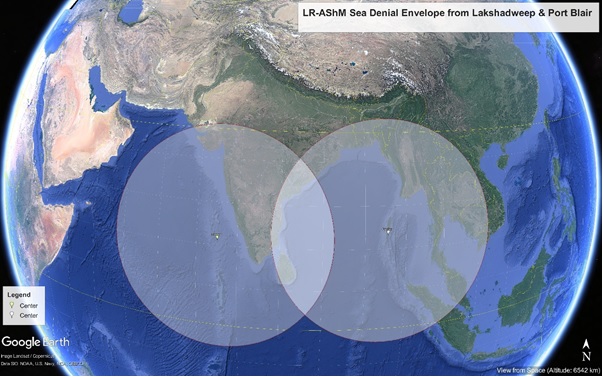
The LR-AShM operationalisation in the IOR shows the sea denial capabilities of the missile against PLAN ships. The Andaman-Nicobar Command’s position near the Malacca Strait exit (Hand, 2026), combined with LR-AShM’s reported 1,500-kilometre range (Indian Defence Research Wing, 2026b), could create significant operational constraints for carrier transiting the area: to pass through the strait, a CSG must enter the WEZ; to avoid the WEZ, a CSG must use longer routes (Sunda, Lombok) with their own limitations.
Figure 1: LR-AShM Sea Denial Envelope from Lakshadweep and Port Blair
Source: Google Earth Pro (2026). Satellite image [Software]. Available at: https://www.google.com/earth/ (Accessed: April 22, 2026). Imagery attribution: Data SIO, NOAA, U.S. Navy, NGA, GEBCO; Image Landsat / Copernicus.
Chokepoint Analysis
The table below highlights major IOR chokepoints (Ballast Markets, 2025a) that are pertinent to PLAN’s CSG transit:
Table 3: IOR Chokepoints: Dimensions, Traffic Volumes and PLAN Relevance
|
S.No |
Chokepoint |
Minimum Width |
Maximum Depth |
2025 Annual Ship Transits (approx.) |
Relevance to PLAN |
|
1 |
Malacca Strait |
2.5 km |
25 m |
100,000+ |
80% of Chinese oil imports |
|
2 |
Sunda Strait |
24 km |
20-70 m |
10,000+ |
Alternative to Malacca |
|
3 |
Lombok Strait |
18 km |
250+ m |
12,000+ |
Deep-water access to Australia |
|
4 |
Strait of Hormuz |
50 km |
50-90 m |
21,000+ |
Gulf oil exports |
|
5 |
Bab El-Mandeb |
25 km |
30-150 m |
24,000+ |
Suez access |
Sources: Author’s compilation based on Ballast Markets reports and corroborating media reports.
LR-AShM claimed 1,500-kilometre range would cover from ANC positions, the entire exit of the Malacca Strait and much of the Andaman Sea (Ballast Markets, 2025b). This geographic configuration offers India a potential asymmetric advantage: land-based launchers could threaten PLAN transits without necessarily exposing naval forces to direct counterattack. The Malacca Strait is also shallow (down to 25 metres), which limits submarine operations, and the PLAN cannot use undersea resources to protect the CSG in this vital chokepoint (Ballast Markets, 2025c).
Andaman-Nicobar Command Geometry
ANC is the only joint tri-service command in India, which was formed in 2001. ANC is positioned on the main SLOC of China, which is located about 1,200 kilometres north of the northern exit of Malacca. The ANC has airfields at Port Blair (INS Utkrosh), Car Nicobar (INS Baaz and Campbell Bay), capable of accommodating fighter aircraft, maritime patrol aircraft and possibly LR-AShM launchers (Christopher Arputharaj & Yusuf, 2025). This capability represents a factor that PLAN planners would likely consider in IOR transit planning.
Calculations of Range and Endurance
With the reported minimum range of 1,000 km and the maximum estimated range of 1,500 km of the LR-AShM, the WEZ can be overlaid on strategic IOR coordinates. The distance between the Andaman & Nicobar Command headquarters at Port Blair (11.7°N, 92.8°E) and the exit of the Malacca Strait (around 6°N, 96°E) is about 1,150 km, which is well within the envelope of the LR-AShM. Port Blair is about 500 km away from the northern Andaman Sea (12°N, 95°E), which provides complete coverage of that basin. The western arc has a launch point at Lakshadweep/Kavaratti (10.5°N, 72.5°E), which covers the Arabian Sea, and the 1,500 km range of the missile is extended to the Gulf of Oman and the Strait of Hormuz approaches. In the case of air-launched variants, a Su-30MKI based in Car Nicobar will be able to reach the Malacca Strait entry point at a distance of about 800 km. Strikes by PLAN carrier strike groups in the Bay of Bengal, Andaman Sea, or eastern Arabian Sea would be within LR-AShM’s WEZ. To remain beyond the reported LR-AShM engagement envelope, PLAN CSGs might be constrained to operating south of 5°S, limiting access to major SLOCs and logistics nodes.
UNREP Vulnerabilities
China does not have any foreign naval bases in the IOR that are similar to the U.S. bases at Diego Garcia. PLAN’s CSGs rely solely on UNREP to support long operations of more than about 10 days. China has been pursuing logistics access at Gwadar (Pakistan), Hambantota (Sri Lanka), and Djibouti. None of these, however, are complete naval bases, able to maintain carriers or to replenish ammunition in large quantities (Sweeney, 2024). UNREP logistics chains are susceptible to interdiction. If India were able to target UNREP ships (Type 901/903) with LR-AShM or other anti-ship missiles, the endurance of PLAN’s CSG would be highly limited. A CSG that is unable to replenish must either go back to port (China), a 5-7 day transit each way, stay on station with reduced capabilities, or run the risk of UNREP in contested waters. Both alternatives undermine the capability of China to sustain IOR presence.
Strategic Recommendations
The maritime doctrine of India, reflected in the Indian Maritime Doctrine 2025 (IMD-25), focuses on multi-domain deterrence provided by layered A2/AD kill webs, with hypersonic effectors such as LR-AShM as high-end multipliers. This overmatch needs to be operationalised with strategic suggestions to use persistent sea denial, deter far-seas force projection, and stabilise IOR escalation ladders. The recommendations that follow are on integration, ISR fusion, operational hardening, and diplomatic off-ramps.
A2/AD Integration
Three priority steps must be undertaken by India to ensure the effectiveness of LR-AShM. The first step is to develop an A2/AD network with LR-AShM (long-range hypersonic), BrahMos (supersonic, 290 km range), and Nirbhay (subsonic loitering, 1,000 km range) (“BrahMos Anti-Ship / Cruise Missile - Defence Update,” 2006). This will create a kill web rather than a kill chain, and therefore, it is challenging for adversaries to architect their defence. Second, harden ANC launchers to counter-battery fire and pre-emptive attack. Mobile launchers, dispersal, and decoys are necessary. Third, develop forward resupply nodes at INS Baaz (Campbell Bay) for sustained time-sensitive targeting (TST). This decreases the response time to emerging targets and makes it difficult to assess battle damage by the adversary. These actions are in line with the focus of the Indian Maritime Doctrine 2025 on MDO. The doctrine explicitly calls for “integrated kill webs” and “persistent, networked, and responsive” targeting.
ISR and QUAD Synergies
India has the following ISR platforms that apply to hypersonic targeting: P-8I Poseidon (maritime patrol aircraft, 12 in service); MQ-9B Sea Guardian (leased by the U.S., 2 in service); NETRA Airborne Early Warning and Control System (AEW&CS); and Radar Imaging Satellite (RISAT) series radar imaging satellites. The Malabar exercises of QUAD involve MDA sharing and cooperative targeting exercises. Air defence exercises from the sea were conducted in the 2024 Malabar exercise (Christopher Arputharaj, 2026). ISR improvements have been recommended as: standardise data fusion protocols between QUAD members to hypersonic targeting, such as common data link standards and track numbering; expand QUAD MDA to real-time cueing of LR-AShM batteries; invest in indigenous AEW&C capability with Over-The-Horizon Targeting (OTHT); and allocate LR-AShM targeting cells to the ANC and Western Naval Command to provide prompt cueing and coordinated action.
Operational Measures
India holds regular exercises such as TROPEX (Theatre-level Operational Readiness Exercise, every two years) and Malabar (annual with QUAD partners) (Press Information Bureau, 2025). Operational integration recommendations would include: incorporate hypersonic live-fire or simulated engagements in Malabar 2026-2028; live-fire of LR-AShM against a target vessel (expendable) would confirm open-source performance estimates; create specific wargaming scenarios of PLAN’s CSG engagement in IOR chokepoints. Also, develop LR-AShM release authority, targeting, and battle damage assessment standard operating procedures (SOPs), including delegation of launch authority to theatre commanders to targets with time constraints. Lastly, perform routine LR-AShM launch drills by surface vessels and Su-30MKI aircraft to confirm operational preparedness and training of the crews.
Diplomatic Confidence-Building Measures
India and China have bilateral agreements, such as the 1996 Agreement on Confidence-Building Measures in the Military Field Along the Line of Actual Control (Joshi, 2020). There is no similar naval CBM in the IOR. The Indian Ocean Naval Symposium (IONS) is a platform of regional naval cooperation, with 25 member states (Kupriianov, 2020). China is, however, not a member. Naval CBM recommendations include: create an IOR naval hotline between the Indian Navy Western Naval Command and PLAN South Sea Fleet, similar to the India-Pakistan hotline; implement pre-notification agreements on CSG transits within 500 kilometres of each other’s Exclusive Economic Zones (EEZs); conduct observer exchanges during TROPEX and PLAN IOR exercises, beginning with low-sensitivity activities (Sawan, 2020). These CBMs minimise the risk of miscalculation without undermining the deterrent posture of India. This is not aimed at removing competition but to manage it below the threshold of armed conflict.
Conclusion
The LR-AShM is the first hypersonic anti-ship missile to be publicly shown in India, unveiled in January 2026 as part of the HSTDV programme. The main technical parameters are boost-glide trajectory, solid-fuel booster, and the reported range of 1,500 kilometres. Preliminary open-source analysis suggests LR-AShM could potentially reduce PLAN’s CADIZ and challenge current CIWS (Type 1130) engagement timelines. A weapon with Mach 5-10 could potentially reduce terminal engagement windows to less than 12 seconds, though this estimate is subject to significant uncertainty. The Andaman-Nicobar Command provides a geometric advantage in the control of the Malacca Strait, and the LR-AShM WEZ covers the entire strait exit. There are still considerable gaps in data: CEP, Pk, warhead weight, and countermeasure effectiveness are not publicly accessible. Any analysis that purports to give certain figures is speculative. PLAN carriers have common weaknesses: UNREP reliance, CIWS saturation limits, and EMALS integration maturity (Fujian). The primary strategic impact of LR-AShM may be deterrence through denial, potentially creating uncertainty for adversary operations.
If operationally deployed and integrated with QUAD’s ISR, LR-AShM could generate three strategic effects. First, strengthen India as a net security provider in the IOR without matching the number of carriers as China does. Second, ensure against the Malacca Dilemma coercion, such that any attempt to blockade would be expensive and unpredictable. Third, develop mutual hypersonic vulnerability with the YJ-21 of China, which may stabilise deterrence by the stability-instability paradox. These effects, however, are contingent on operational preparedness, ISR integration, and plausible political will to use the weapon during a crisis.
Disclosure Statements: The author states that this paper has neither been published nor submitted for publication, either in whole or in part, in a professional journal or as a part of a book which is formally published or for internal purposes in any institution, and has not been made available to the public. The author has no conflicts of interest. There are no financial or personal relations that have influenced the work. This research was not funded. It is part of the author’s PhD research from the Central University of Gujarat, Vadodara, India. In the event of acceptance, the author agrees to publish the manuscript in the Electronic Journal of Social and Strategic Studies (ISSN online: 2582‑9645) and retains the right to publish such a publication in the journal, as per the journal’s policy. No AI tools were used for research content; QuillBot AI was used solely for grammar checking, and the author takes full responsibility for the final manuscript.
Acknowledgements: The author would like to acknowledge his PhD supervisor, Dr Amit Mukherjee of the Department of Strategic Technologies, for his academic guidance; Prof. Sanjay Kumar Jha, Dean, School of National Security Studies, for his support; and Dr Vishwas Raval, Head of the Department, for his encouragement. The author acknowledges the use of HPC-GIS Laboratory facilities of the DST-SNSS-CUG for the preparation of the article.
References:
Acton, J. (2018, April 2). Hypersonic Weapons Explainer. Retrieved April 23, 2026, from Carnegie Endowment for International Peace website: https://carnegieendowment.org/posts/2018/04/hypersonic-weapons-explainer
Acton, J. M. (2015). Hypersonic Boost-Glide Weapons. Science & Global Security, 23(3), 191–219. https://doi.org/10.1080/08929882.2015.1087242
Admin. (2026, April 5). India’s Hypersonic Trident: How Dhvani, LR-AShM, and ET-LDHCM Are Reshaping Strategic Deterrence. Retrieved April 25, 2026, from Indian Defence Research Wing website: https://tinyurl.com/3aswkjfm
An Anti-Access History Lesson. (2012, May 25). Retrieved April 23, 2026, from The Diplomat website: https://thediplomat.com/2012/05/an-anti-access-history-lesson/
Antonucci, H. (2025, August 28). The Denial Navy: A Strategic Concept for American Maritime Security—Center for Maritime Strategy. Retrieved April 23, 2026, from Centre for Maritime Strategy website: https://tinyurl.com/2yamnfj6
Army Recognition Group. (2020, October 29). Chinese Navy Type 002 Shandong aircraft carrier continues to strengthen. Retrieved April 26, 2026, from https://tinyurl.com/4kevjpsn
Army Recognition Group. (2025, March 4). China sends Shandong Carrier Strike Group to within 24 nautical miles of Taiwan’s coast in largest drill of 2025. Retrieved April 26, 2026, from https://tinyurl.com/5fsuwfsj
Ballast Markets. (2025a). Chokepoint Risk Trading: Geopolitical Events to Markets. Retrieved April 26, 2026, from https://content.ballastmarkets.com/learn/modules/chokepoint-risk/
Ballast Markets. (2025b). Lombok Strait: Deep-Water Submarine Corridor & Strategic... Retrieved April 26, 2026, from https://content.ballastmarkets.com/chokepoints/lombok-strait/
Ballast Markets. (2025c). Sunda Strait: Malacca Alternative Route & VLCC Diversion... Retrieved April 26, 2026, from https://content.ballastmarkets.com/chokepoints/sunda-strait/
BrahMos Anti-Ship / Cruise Missile-Defence Update: (2006, November 29). Retrieved April 27, 2026, from Defence Update website: https://defense-update.com/20061129_brahmos-2.html
Brahy, J. (2025, November 17). China increases Type 903A replenishment oiler fleet to extend naval reach across the Pacific. Retrieved April 26, 2026, from Army Recognition Group website: https://tinyurl.com/4tppr4w8
Brahy, J. (2026, January 26). New LR-AShM hypersonic anti-ship missile strengthens India’s long-range coastal strike. Retrieved April 26, 2026, website: https://tinyurl.com/ye2b4xdz
Braun, V., & Clarke, V. (2006). Using thematic analysis in psychology. Qualitative Research in Psychology, 3(2), 77–101. https://doi.org/10.1191/1478088706qp063oa
China Daily. (2025, September 23). CNS Fujian achieves milestone with electromagnetic launch of advanced Naval aircraft_ News_ Fujian Provincial People’s Government. Retrieved April 26, 2026, from https://www.fujian.gov.cn/english/news/202509/t20250923_7013669.htm
Choudhary, M. (2023, February 6). China’s Malacca Bluff: Examining China’s Indian Ocean Strategy and Future Security Archite. Retrieved April 23, 2026, from Air University (AU) website: https://tinyurl.com/37pukpp3
Christopher Arputharaj, B. (2026, February 24). India’s Maritime Partnership Exercises (MPX) and Regional Stability. Retrieved April 27, 2026, from Diplomatist website: https://tinyurl.com/46w86fc3
Christopher Arputharaj, B., & Yusuf, M. (2025). Andaman and Nicobar Islands: India’s Strategic Fulcrum for Malacca Strait Control and Power Projection. In Maritime Geopolitics and Security in the Indian Ocean Region (pp. 174–189). New Delhi: Bharti Publications. Retrieved from https://tinyurl.com/bdey27da
Complex Air Defense: Countering the Hypersonic Missile Threat. (2022, February 7). In Centre for Strategic and International Studies. Retrieved from https://tinyurl.com/4ym3frpn
D. KAPLAN, R. (2011). Monsoon: The Indian Ocean and the Future of American Power. Retrieved April 24, 2026, from Association for Asian Studies website: https://tinyurl.com/4eksu9b9
Defence Security Asia. (2026, January 23). India to Unveil Long-Range Hypersonic Anti-Ship Missile at Republic Day 2026, Signalling a New Era of Maritime Strike Power. Retrieved April 26, 2026, from https://tinyurl.com/2aekz9ux
Fetter, S., Thies, T., & Mizin, V. (2024). Hypersonic Glide Vehicles: Evaluating inadvertent escalation risks. https://doi.org/10.5281/ZENODO.11258958
Ghosh, P. (2020, August 31). India’s Indian Ocean Region Strategy. Retrieved April 23, 2026, from Journal of Indo-Pacific Affairs website: https://tinyurl.com/yc32ab3h
Gomez, E. (2016, July 4). Taiwan’s Best Option for Deterring China? Anti-Access/Area Denial | Cato at Liberty Blog. Retrieved April 23, 2026, from CATO Institute website: https://tinyurl.com/32y55vak
Haldar, S. (2025, March 9). The Quad’s Calibrated Maritime Security Agenda. Retrieved April 24, 2026, from Orfonline.org website: https://www.orfonline.org/research/the-quad-s-calibrated-maritime-security-agenda
Hand, M. (2026, April 20). Malacca Strait vessel traffic at record levels in 2025. Retrieved June 29, 2026, from Seatrade Maritime News website: https://www.seatrade-maritime.com/tankers/malacca-strait-vessel-traffic-at-record-levels-in-2025
Hillman, J. E. (2018). China’s Belt and Road Is Full Of Holes. Retrieved from https://www.csis.org/analysis/chinas-belt-and-road-full-holes
Hypersonic Technology Demonstration Vehicle (HSTDV). (n.d.). Retrieved April 25, 2026, from https://www.globalsecurity.org/military/world/india/hstdv.htm
Indian Defence Research Wing. (2024, November 21). DRDO Plans to Conduct Extended Hypersonic Technology Demonstrator Vehicle (HSTDV) Tests. Retrieved April 25, 2026, from https://tinyurl.com/4sm4hud6
Indian Defence Research Wing. (2026a, January 30). LRAShM’s 1,500 km Reach Turns India’s Island Territories into a Powerful Sea-Denial Shield. Retrieved April 26, 2026, from https://tinyurl.com/yr8tjdrp
Joshi, M. (2020, June 8). Indo-China row signals breakdown of confidence building measures. Retrieved April 27, 2026, from Orfonline.org website: https://tinyurl.com/f3r9nfa4
K. Denzin, N. (2009). The Research Act | A Theoretical Introduction to Sociological Methods. Retrieved April 24, 2026, from https://tinyurl.com/39d2vtu5
Kamara, H. M. (2020). Countering A2/AD in the Indo-Pacific: A Potential Change for the Army and Joint Force. Joint Force Quarterly. Retrieved from https://tinyurl.com/3usmzj4s
Kelley M., S. (2025, August 27). Hypersonic Weapons: Background and Issues for Congress [Legislation]. Retrieved April 23, 2026, from https://www.congress.gov/crs-product/R45811
Kumar, A. (2025, October 17). India’s LR-AShM Hypersonic Missile Moves into Serial Production after Successful Trials. Retrieved April 25, 2026, from The Defense News website: https://tinyurl.com/5dwhympu
Kumar, Atul. (2025, January 12). China’s Expanding Aircraft Carrier Capabilities: From a Carrier Gap to the Electric-Catapult Age. Retrieved April 23, 2026, from Orfonline.org website: https://tinyurl.com/4xhmpap5
Kumar Singh, A., & Vignesh, R. (2026, September 3). Indian Maritime Doctrine 2025: An Assessment. Retrieved April 23, 2026, from MP-IDSA website: https://idsa.in/publisher/issuebrief/indian-maritime-doctrine-2025-an-assessment
Kupriianov, A. (2020). The Indian Ocean Naval Symposium. World Economy and International Relations, 64, 80–88. https://doi.org/10.20542/0131-2227-2020-64-2-80-88
Liaoning Type 001. (2026, January 15). Retrieved April 26, 2026, from Army Recognition Group website: https://tinyurl.com/yssamcat
Long Range Anti-Ship Hypersonic Missile (LR-AShM). (2026, April 4). Retrieved April 26, 2026, from https://samsamayikghatnachakra.com/current_news/17795?language=all
Luck, A. (2025, July 11). Chinese Navy Takes Aircraft Carrier Fujian Into Active Service. Retrieved April 23, 2026, from Naval News website: https://tinyurl.com/3derp6x4
Ludwig Besser, H., & Dennis, G. (2017, July 14). Hypersonic Vehicles—Joint Air Power Competence Centre. Retrieved April 26, 2026, from https://www.japcc.org/articles/hypersonic-vehicles/
Manning, M. (2021). Sea Control: Feasible, Acceptable, Suitable, or Simply Imperative. Journal of Advanced Military Studies, 11(2), 51–73. https://doi.org/10.21140/mcuj.20201102003
Menon, A. K. (2026, January 29). India showcases first Hypersonic Anti-Ship Missile System in national parade. Retrieved April 25, 2026, from Naval News website: https://tinyurl.com/2ezkvrar
MotoArt. (2016, March 2). Aircraft History of the MK-84 Bomb |. Retrieved April 25, 2026, from https://tinyurl.com/3ymb3z8w
M.Raj. (2025, December 3). India’s Mach 10 “Carrier Killer” LR-AShM: The Hypersonic Missile That Changes Everything in 2025 - NDA Study. Retrieved April 23, 2026, from https://ndastudy.com/indias-mach-10-carrier-killer-lr-ashm/
NDTV News Desk. (2026, 01). Hypersonic Speed, 1,500 Km Range: DRDO’s Missile to Debut on Republic Day. Retrieved April 23, 2026, from Www.ndtv.com website: https://tinyurl.com/ya2zhbcb
P. Carlson, C. (2020, March 11). CMSI China Maritime Report #10: “PLAN Force Structure Projection Concept: A Methodology for Looking Down Range” | Andrew S. Erickson. Retrieved April 23, 2026, from Andrew S. Erickson website: https://tinyurl.com/ptwkkhs4
P.P. Dosson, R. (2025, August 7). The Malacca Dilemma: China’s Achilles’ heel—Modern Diplomacy. Retrieved April 23, 2026, from Modern Diplomacy website: https://moderndiplomacy.eu/2025/07/08/the-malacca-dilemma-chinas-achilles-heel/
Praveen. (2017, November 29). Type 901 Class Fleet Replenishment Ship. Retrieved April 26, 2026, from Naval Technology website: https://tinyurl.com/y6nzca69
Press Information Bureau. (2025, July 2). THEATRE LEVEL OPERATIONAL READINESS EXERCISE (TROPEX-25). Retrieved April 27, 2026, from https://www.pib.gov.in/www.pib.gov.in/Pressreleaseshare.aspx?PRID=2100813
Quraishi, S. G., Shaikh, S. R., Dhole, D. G. S., Goswami, S. M., Mohapatra, S. R. S., Gn, S. S., … Aggarwal, S. (2026). DRDO Newsletter. A Monthly Bulletin of Defence Research and Development Organisation, 46(2). Retrieved from https://drdo.gov.in/drdo/sites/default/files/publication-document/NL_Feb2026.pdf
Republic Day 2026: DRDO to Reveal LR-AShM Hypersonic Missile Which Travels 1,500 Km in 15 Minutes. (2026a, January 23). Retrieved April 23, 2026, from Newsd Defence website: https://tinyurl.com/hatv33rz
Republic Day 2026: DRDO to showcase its path-breaking innovations at Kartavya Path & Bharat Parv. (2026b, January 22). Retrieved April 23, 2026, from Press Information Bureau website: https://www.pib.gov.in/www.pib.gov.in/Pressreleaseshare.aspx?PRID=2217280
Roshan, H. (2025, April 10). The Great Game At Sea: An Analysis Of The Sino-Indian Strategic Competition In The Indian Ocean. Retrieved April 23, 2026, from Center for International Relations and Strategic Studies website: https://www.impriindia.com/insights/sino-indian-strategic-competition/
S. Nicanci, T. (2026, October 3). China Commissions Two New Type 055 Destroyers Assigned to Eastern Theater Command Near Taiwan. Retrieved April 26, 2026, from Army Recognition Group website: https://tinyurl.com/42ksmkkf
Sawan, C. R. S. (2020). Problems and prospects of maritime security cooperation in the Indian Ocean Region: A case study of the Indian Ocean Naval Symposium (IONS). (15). Retrieved from https://seapower.navy.gov.au/sites/default/files/2023-02/Soundings_No_15.pdf
Sen, L. (2026, February 22). Golden Shield for Vessels: Type 1130 Close-In Weapon System (10,000-Round Gun)—Ministry of National Defense. Retrieved April 25, 2026, from http://eng.mod.gov.cn/2025xb/D/S/16443188.html
Servaes, A. (2025, October 11). China Fujian vs. U.S. Ford: China’s New Aircraft Carrier Challenges U.S. Navy’s Most Advanced Warship. Retrieved April 26, 2026, from Army Recognition Group website: https://tinyurl.com/2hajred7
Sinha, S. (2023, August 3). BrahMos Supersonic Cruise Missile-Superlative Weapon For ‘Cruise Missile Triad.’ Retrieved April 23, 2026, from Indian Aerospace and Defence Bulletin—News for aerospace and defence in India website: https://tinyurl.com/tt5by3he
Skunstiņš, G., & Berzina, I. (2025). Technological maturity for Jeune École: The case of Ukraine’s naval strategy. Security Defence Quarterly. https://doi.org/10.35467/sdq/211261
Sweeney, M. (2024, May 1). Challenges to Chinese blue-water operations. Retrieved April 26, 2026, from Defense Priorities website: https://tinyurl.com/2msk3z4s
Tracy, C. L., & Wright, D. (2020). Modeling the Performance of Hypersonic Boost-Glide Missiles. Science & Global Security, 28(3), 135–170. https://doi.org/10.1080/08929882.2020.1864945
Wertheim, E. W. M., Washington, a defense consultant in the, D.C., area, & Biography, is the author of the 16th edition of T. N. I. G. to C. F. of the W. from the N. I. P. M. S. F. T. A. V. (2023, March 1). Type 055 Renhai-class Cruiser: China’s Premier Surface Combatant. Retrieved April 26, 2026, from U.S. Naval Institute website: https://tinyurl.com/yc2wuxub
Xuanzun, L., & Rui, L. (2026, March 13). PLA Navy’s new Type 052D destroyer conducts maiden training with newly debuted Type 055 destroyer, official media reports show—Global Times. Retrieved April 26, 2026, from Global TImes website: https://www.globaltimes.cn/page/202603/1356900.shtml
Zeyuan, Y. (2025, October 11). China’s Fujian hits the water—Next carrier already in the works. Retrieved April 23, 2026, from ThinkChina—Big Reads, Opinions & Columns on China website: https://tinyurl.com/y4x72fyv
Zhong, W., Zhao, Z., Yuan, K., & Tang, R. (2025, July 7). Effect of plasma sheath on high hypersonic vehicle communication systems | Physics of Plasmas | AIP Publishing [Physics of Plasma]. Retrieved April 23, 2026, from https://tinyurl.com/mdkxyf7u
Zimmerlie, A. (2023). Corbett Down Under: Sir Julian Corbett, Maritime Strategy, and Australian Land Power in the Indo-Pacific Arc | Australian Army Research Centre (AARC). 19(2). Retrieved from https://tinyurl.com/5d46uc7d