
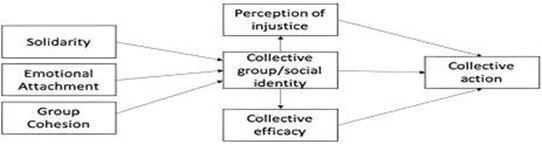
 |
Figure 1: Drivers of Collective Action
Source: Adapted from Brünker et al. (2019), p. 304.
This theoretical framework of collective identity and action finds practical manifestation in contemporary environmental movements. As Francesconi et al. (2021) argue, FFF has achieved a notable balance between strong collective agency and iconic leadership, which is challenging for most large-scale movements. While environmental movements have historically been shaped by diverse demographics and characterised by distinct traits reflecting the complexity of ecological challenges, they traditionally re- quired access to financial, human, and informational resources to effect change (McCarthy & Zald, 1977). This resource dependency led to the rise of organisations such as Greenpeace, Friends of the Earth, and WWF, along with grassroots collectives that allowed resource mobilisation and structured support. The resource mobilisation theory (McCarthy & Zald, 1977) sheds light on how these organisations sustained and grew their influence, mobilising resources and effectively translating public concern into structured, actionable agendas.
#thereisnoplanetb: Why FFF is Different
However, FFF represents a departure from this traditional model. Collective social agency in FFF enables the movement to function as a cohesive entity, embodying shared objectives and a unified message across its global network (Brünker et al., 2019), replacing the need for support from large organisations. When analysed through complex systems theory and enactive cognition, FFF is a dynamic, multi-layered network composed of interconnected sub-networks. This structure resembles a ‘meta-network’ with a fractal and nested design that supports collective action, non-hierarchical organisation, and distributed learning (Castellano et al., 2009). Although FFF International serves as the movement’s core, it comprises numerous local chapters, each operating autonomously but interconnected. This bottom-up, self- organising structure has effectively mobilised individuals and coordinated local, national, and global actions. The movement’s coordination across countless individual goals and motivations — particularly in a network as large and decentralised as FFF — illustrates its ability to achieve an integrated structure through distributed leadership (Brünker et al., 2019).
This distributed leadership model aligns with FFF’s governance approach, characterised by self-organisation rather than traditional hierarchy, underscoring a unique form of leadership that supports rather than directs. This self-governance enables FFF to remain mission-oriented and united in its ethical commitment to combat climate change. It fosters solid internal cohesion that motivates ongoing activism among its largely youth-led base (Stratton, 2021). Greta Thunberg, FFF’s public face, identifies herself as a spokesperson rather than a leader, subverting conventional leadership roles in a way that reinforces FFF’s ethos of decentralised, bottom-up action (de Moor et al., 2020).
#strikeathome: Technology and Interaction
The movement’s success challenges the traditional logic of collective action, typically linked to significant organisational resources and collective identity formation. It adopts some elements of the newer concept of connective action, which relies on personalised content sharing across media networks (Bennett & Segerberg, 2012). Information and communication technologies (ICTs) and the pervasive influence of global issues such as climate change and economic liberalisation have facilitated this evolution. ICT advancements reduce the cost and logistics of collective action, providing more resilient networks of activists. Digital tools allow movements to be organised without physical gatherings. This era of ‘net- worked’ activism (Terren & Soler-i-Martí, 2021) connected well-educated protesters across the globe who target international bodies and economic elites. FFF’s communication strategies — short, consistent messages across social media — help maintain its internal solidarity and external impact, enabling it to engage with a global audience and sustain collective motivation (Scheitle, 2020).
The dual embodiment of FFF in physical and digital spaces illustrates the movement’s enactive approach to knowledge as a lived, interactive process. The movement’s origins in Greta Thunberg’s solo protest reflect its grounded, embodied beginnings. At the same time, its rapid spread through online platforms shows a feedback loop where digital amplification leads to tangible actions worldwide (Francesconi et al., 2021). In conclusion, FFF exemplifies a new model of collective agency in environmental movements that successfully combines distributed leadership, technological innovation, and youth engagement. The movement’s ability to maintain cohesion while operating through decentralised networks demonstrates the evolving nature of collective action in the digital age. Yet this organisational innovation must be assessed critically: the movement’s dependence on digital infrastructure and youth leadership, while enabling rapid mobilisation, simultaneously raises questions about who is included in and excluded from this model of activism (Kumar & Singh, 2023).
Agenda Framing
The evolution of FFF as a modern protest movement demonstrates a significant shift in how environmental activism is framed and communicated. This section explores how agenda-setting activities took shape within the FFF movement using textual, visual, and satirical elements. The agenda-framing strategies that combined personalised narratives with emotions and science bridged the gap between the personal and the collective, creating a unique model of ‘localised’ activism that was connected to the global movement and was further enhanced by digital technologies through which it spread.
#ourfutureisindanger: Personalising Climate Change
Modern protest networks often operate with minimal reliance on traditional, hierarchical organisation. Instead, they leverage digital media to foster personal engagement, allowing individuals to self-organise around shared causes rather than relying on established advocacy groups to set the agenda. This move away from traditional solidarity institutions, such as political parties and organisations, has led individuals to engage in political action that reflects personal lifestyle choices (Giddens, 1991; Beck & Beck-Gernsheim, 2002, p.28).
This phenomenon manifests in the personalisation of critical issues like climate change, where individuals align their activism with their values and consumption patterns. Shim (2024) explores the unique frames that situate FFF within a ‘protest paradigm’ that portrays them as disruptive or contentious. Activists then actively shape their own narrative by directly engaging with audiences on social media. He argues that FFF activists use Instagram not just to share information but to build a narrative that brings the global climate crisis to a personal level. By sharing individual stories, images, and videos that reflect personal engagement with climate issues, they make the broader issue of climate change relatable and accessible. This personalisation is essential in appealing to younger generations who connect more with personal stories than abstract data or distant narratives (see Figure 2). By bridging both organisational and personal networks, digital tools promote the spread of information and calls to action across communities (de Moor et al., 2020). This is precisely what is meant by a ’personal action frame’: the individual perspective and motivation that, when shaped and shared through digital platforms, becomes the building block of collective mobilisation (Francesconi et al., 2021).

Figure 2: Personalized Communication
Source: Fridays for Future India Instagram page, accessed 1 November 2024.
#letusbreathe: Visual Storytelling and Local Narratives
The Fridays for Future movement effectively harnesses the power of social media to make the complex and often abstract issue of climate change accessible and relatable through visual storytelling. The visualisation is flexible in definition and deeply personal, often utilising local imagery and videos to illustrate the unique impacts of climate change on specific communities. This can be seen through Fridays for Future India’s Instagram page, where topics such as state floods, urban heatwaves, and deforestation are discussed utilising local imagery and videos to illustrate the unique impacts of climate change on specific communities and places (see Figure 3). This approach emphasises how global climate challenges translate into local realities, encouraging empathy and mobilisation. FFF groups worldwide highlight regional concerns — such as deforestation in Brazil, energy dependency in Germany, and waste management in India — using visual narratives that link these issues to global climate concerns (Beck & Beck-Gernsheim, 2002, p.29).
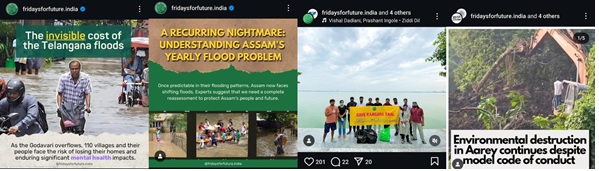
Figure 3: Utilization of Local Imagery and Videos
Source: Fridays for Future India Instagram page, accessed 1 November 2024.
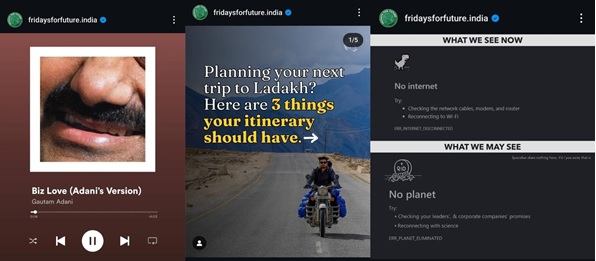
Figure 4: Usage of Memes
Source: Fridays for Future India Instagram page, accessed 1 November 2024
Activists often convey messages through performative content — short videos, lip-syncs, dance, and humorous memes — which resonate with youth audiences and make complex environmental issues more relatable. For example, FFF activists in India have used symbolic performances, playing multiple roles to critique political indifference to environmental crises. Memes often humorously juxtapose environmental messages with local cultural symbols, creating relatable content that appeals to younger audiences (see Figure 4). Individual-driven action encourages a diverse, personalised agenda frame, moving to appear inclusive and adaptable to personal motivations, which can strengthen solidarity among participants across digital platforms (de Moor et al., 2020). These actions are furthered by social media, where platforms like Instagram provide activists with a space to not only bypass mainstream media’s traditional framing but also to build a community and collective identity through personalised yet universally relatable narratives (Beck & Beck-Gernsheim, 2002).
#howdareyou: Emotions in Agenda Framing
The emotional dynamics and justice framing of FFF represented a distinctive approach to environmental activism, where affect and equity considerations were deeply intertwined. Research indicates that FFF activists experienced a complex emotional landscape that drives and sustains their involvement in climate action. The movement effectively channelled what Kleres & Wettergren (2017) described as ‘emotional energy’ into collective action, transforming individual anxiety and frustration into powerful mobilising forces. Studies of FFF participants revealed that climate anxiety catalysed action when coupled with collective hope (de Moor et al., 2020). This emotional duality was particularly evident in how young activists framed their engagement — combining urgent concern about climate impacts with an optimistic belief in collective power for change. The movement’s success in mobilising millions globally can be partially attributed to what Thunberg calls ‘rational anxiety’, where emotional responses to the climate crisis are validated and redirected toward constructive action (Joost et al., 2020).
#fightingforabetterworld: Identity and Collaboration
The influence of these narratives can be understood through research which finds that social identities and activist self-identity strongly predict participation in environmental protests, particularly in the FFF movement (Fridays for Future, 2021). This suggests that identifying personally with FFF and embracing an activist identity may be a more powerful motivator for collective action than simply holding pro-environmental values. By framing individual experiences within broader narratives, this approach strengthens community bonds through shared stories, uniting diverse accounts into a universal message of climate justice (Beck & Beck-Gernsheim, 2002).
FFF’s reach extends beyond environmental activism into collaborations with external networks like Sci- entists4Future and Entrepreneurs4Future, which enrich the movement’s knowledge base and expand its influence across scientific and professional sectors (Scientists 4 Future, 2024). These alliances have allowed FFF to access scientific expertise and practical sustainability strategies. FFF becomes a hybrid organisational structure where traditional advocacy groups work alongside digitally mobilised, decentralised networks. This hybrid model enables a unique approach to framing issues based on structured advocacy and spontaneous digital engagement. The agenda is framed through a collaborative process, where institutional goals are interwoven with grassroots contributions, creating a multi-layered action frame that appeals to a broader public (Chadwick, 2007).
#climatechangeishere: Localised or Globalised Agenda Framing?
By highlighting how climate change affects specific local environments, FFF makes the global crisis feel immediate and personal. To make a case for India, I draw from a study conducted in Barcelona (Terren & Soler-i-Martí, 2021) which highlights the ‘glocal’ and transversal approach to activism. According to the study, ICTs allow FFF activists to network internationally while organising local events and campaigns. They have a global vision but act locally on regional issues and tailor their campaigns to resonate with local communities. This means that while the global identity binds the movement, each chapter adapts its goals to local contexts, addressing community-specific concerns like air pollution, waste management, or urban green spaces while also targeting city-level policy changes, helping build community resilience and encouraging citizens to hold local officials accountable (see Figure 5). In doing so, local chapters do not simply reproduce the global frame but actively reshape it through personal action frames that reflect their own political and ecological realities
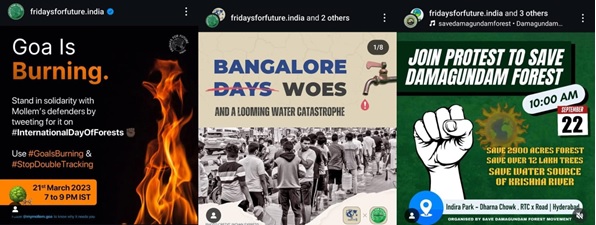
Figure 5: Region-specific Issue Depiction
Source: Fridays for Future India Instagram page, accessed 1 November 2024.
There is a sense of transversality that integrates various social, economic, and political issues into the climate agenda and reflects a broader trend wherein activists advocate for interconnected social justice concerns, recognising the overlap between climate change and other societal issues (Bennett & Segerberg, 2012). This was seen through a focus on material and post-material issues such as access to public services or global warming and an emerging cosmopolitanism that rested on acknowledging everyone as worthy human beings regardless of our differences.
This can also be connected to what Rajan (2024) describes as ‘universal justice’ frames created by the youth-led climate justice movement, which has far-reaching consequences leading to the deviation of children from adult capitalist ideology. In India, this phenomenon could be seen in the Disha Ravi case (Ellis-Petersen, 2021), where climate justice was read through farmers’ protests, among others. As theorised by Cederlöf & Sivaramakrishnan (2006), the collision of globally circulating justice frames with India’s specific histories of resource conflict and state repression produces outcomes that cannot be predicted from the movement’s global logic alone. The Disha Ravi episode is a case study in how a universalist climate frame becomes a site of geopolitical contest when it intersects with the state’s interest in containing dissent.
The movement’s success in creating what can be termed ‘glocalized’ activism demonstrates how modern environmental movements can effectively navigate between local specificities and global objectives. Through its innovative use of digital platforms, strategic partnerships, and emphasis on personalised engagement, FFF has created a multi-layered framework that allows for both individual expression and collective action.
#climatechangeisreal: The Dependence on Science
FFF is distinguished by its strong reliance on scientific knowledge, which informs its activism and educational messaging. From its inception, FFF has emphasised the critical role of science in understanding and addressing the climate crisis, often showcasing climate data and scientific findings to underline the urgency of climate action (Francesconi et al., 2021). Through campaigns such as ‘Unite Behind Science’, FFF encourages public alignment with the scientific consensus on climate issues and promotes science-based solutions (Whang, 2020), positioning science as the authoritative foundation for climate advocacy (Evensen, 2019). This commitment to science has bolstered FFF’s credibility and enabled it to collaborate with climate scientists and institutions.
FFF’s science-centric approach is a bidirectional conduit, bridging the scientific community and the general public. This role allows FFF to reframe complex climate data into accessible messages, effectively translating scientific findings for broader audiences. By actively endorsing the work of scientists and integrating these insights into its activism, FFF fosters a deeper public understanding of climate science, countering misinformation and promoting climate literacy (Hagedorn et al., 2019). In India, FFF also does this through its Instagram page (see Figure 6)
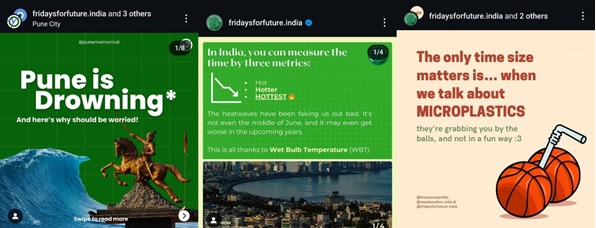
Figure 6: Translating Scientific Discourse
Source: Fridays for Future India Instagram page, accessed 1 November 2024
Unlike many social movements, FFF’s unique, science-oriented structure has attracted significant support from scientists. In 2019, over 3,000 scientists endorsed FFF’s climate strike, validating its calls for immediate action (Han & Ahn, 2020). Through such collaboration, FFF establishes itself as a credible mediator of scientific knowledge, amplifying climate warnings and demands for systemic change.
FFF’s educational role extends beyond the mere dissemination of climate facts. It integrates science- based learning into its activism, creating a paideutic, or educational, environment where activists engage with scientific knowledge dynamically, adapting it for diverse social and ecological contexts. FFF draws from the concept of enactive learning, where activists develop knowledge through active engagement with the climate crisis. This framework fosters an adaptable approach to climate education and positions FFF as a powerful social learning network. However, this science-centric model also carries an epistemological risk: by privileging formal scientific knowledge as the authoritative basis for climate advocacy, FFF may inadvertently marginalise indigenous and local environmental knowledge systems that have historically sustained environmental resistance in the Global South (Cederlöf & Sivaramakrishnan, 2006).
Conclusion
The Fridays for Future movement represents a significant evolution in environmental activism. Throughout this paper, I have identified key dimensions that characterise FFF’s unique contribution to social movements: the clever use of technology for mobilisation and agenda-framing, the shaping of a unique collective conscience through personalised action frames, and the negotiation of the global-local tension through glocalized forms of engagement. However, as the theoretical framework established at the outset of this paper makes clear, celebrating these achievements must not come at the cost of rigorous analysis.
Applying Della Porta and Diani’s multi-dimensional framework, FFF has been demonstrably effective at broadening public discourse, partially effective in shifting policy agendas in select national contexts, and largely unproven in producing institutional transformation. The agenda framing analysis reveals how this mobilisation is sustained — through emotionally resonant, science-backed messaging that bridges the personal and the collective, and through visual storytelling that makes the abstract crisis of climate change locally legible. Yet these same strategies contain the seeds of the movement’s limitations: the emphasis on digital platforms, school strikes, and science literacy as primary repertoires of contention presupposes a participant who is urban, educated, and digitally connected.
Most significantly, the engagement with Cederlöf and Sivaramakrishnan’s work on South Asian environmentalism reveals that FFF’s global justice frame, while powerful in mobilising urban, digitally connected youth, sits uneasily alongside the ’environmentalism of the poor’ that has historically characterised environmental politics in India. Where FFF frames climate action through school strikes and Instagram campaigns, it draws on repertoires of contention that resonate among English-educated, digitally connected youth far more than among communities whose environmental struggles are inextricably tied to immediate livelihood concerns. Its alliance with established scientific frameworks, while lending credibility, can simultaneously reinforce epistemological hierarchies that privilege Western scientific knowledge over indigenous and local environmental knowledge systems — what scholars term ‘epistemic closures’ that narrow the possibility of plural pathways toward environmental justice (Ghosh & Joshi, 2022).
This tension is exemplified in the Indian context, where Greta Thunberg’s association with FFF has be- come a double-edged sword. While the movement’s presence in India signals global interconnectedness, the actor-centred framing of environmental problems that challenge India’s development trajectory has drawn criticism as Western imposition (Olstedt, 2019). Consequently, what began as a youth-led climate movement has become entangled in broader geopolitical narratives about Western influence and Global South development priorities, potentially undermining its original intergenerational justice framework? This proves that while FFF has successfully globalised climate consciousness and mobilised unprecedented youth participation, its implementation reveals complex tensions, particularly in North-South dynamics. These tensions highlight how even well-intentioned global movements can inadvertently reproduce existing power hierarchies and epistemological biases (Kumar & Singh, 2023).
This analysis of FFF reveals several critical areas for future research. A key priority is conducting comparative analyses across different Global South contexts to understand how the movement’s reception and impact varies across cultural landscapes. Future research should examine how power dynamics manifest within supposedly horizontal movement structures and what strategies might mitigate unintended power imbalances. Scholars should also investigate successful models for local adaptation, exploring how movements can maintain global coherence while accommodating local environmental priorities. Finally, research should examine how generational identity functions differently across cultural contexts and interacts with other forms of social hierarchy in environmental movements.
References:
Beck, U., & Beck-Gernsheim, E. (2002). Individualization: Institutionalized individualism and its social and political consequences. SAGE.
Bennett, W. L., & Segerberg, A. (2012). The logic of connective action: Digital media and the personalization of contentious politics. Information, Communication & Society, 15(5), 739–768. https://doi.org/10.1080/1369118X.2012.670661
Blackwood, L. M., & Louis, W. R. (2012). If it matters for the group then it matters to me: Collective action outcomes for seasoned activists. British Journal of Social Psychology. https://doi.org/10.1111/j.2044-8309.2010.02001.x
Brünker, F., Deitelhoff, F., & Mirbabaie, M. (2019). Collective identity formation on Instagram: Investigating the social movement Fridays for Future. arXiv preprint. https://arxiv.org/abs/1912.05123
Castellano, C., Fortunato, S., & Loreto, V. (2009). Statistical physics of social dynamics. Reviews of Modern Physics, 81, 591–646. https://doi.org/10.1103/RevModPhys.81.591
Cederlöf, G., & Sivaramakrishnan, K. (Eds.). (2006). Ecological nationalisms: Nature, livelihoods, and identities in South Asia. University of Washington Press.
Chadwick, A. (2007). Digital network repertoires and organizational hybridity. Political Communication, 24(3), 283–301.
Dalton, R. J. (2015). The good citizen: How a younger generation is reshaping American politics (Rev. ed.). CQ Press.
Davis, J. L., Love, T. P., & Fares, P. (2019). Collective social identity: Synthesizing identity theory and social identity theory using digital data. Social Psychology Quarterly.
de Moor, J., Uba, K., Wahlström, M., Wennerhag, M., & De Vydt, M. (2020). Protest for a future II: Composition, mobilization and motives of the participants in Fridays for Future climate protests. https://urn.kb.se/resolve?urn=nbn:se:sh:diva-40271
della Porta, D., & Diani, M. (2006). Social movements: An introduction (2nd ed.). Blackwell.
Ellis-Petersen, H. (2021, February 19). Disha Ravi: The climate activist who became the face of India’s crackdown on dissent. The Guardian. https://www.theguardian.com/world/2021/feb/18/disha-ravi-the-climate-activist-who-became-the-face-of-indias-crackdown-on-dissent
Evensen, D. (2019). The rhetorical limitations of the #FridaysForFuture movement. Nature Climate Change, 9, 428–430. https://doi.org/10.1038/s41558-019-0481-1
Fisher, S. R. (2019). Life trajectories of youth committing to climate activism. Environmental Education Research, 25(2), 341–364.
Francesconi, D., Symeonidis, V., & Agostini, E. (2021). Fridays for Future as an enactive network: Collective agency for the transition towards sustainable development. Frontiers in Education, 6. https://doi.org/10.3389/feduc.2021.636067
Fridays for Future India. (n.d.). Instagram page. Retrieved November 1, 2024, from https://www.instagram.com/fridaysforfuture.india
Fridays for Future. (2021). Social identity and activist self-identity predict participation in collective environmental protest behavior.
Ghosh, A., & Joshi, R. (2022). Critical perspectives on youth climate activism in the Global South. Environmental Politics, 31(2), 45–62.
Giddens, A. (1991). Modernity and self-identity: Self and society in the late modern age. Stanford University Press.
Hagedorn, G., Loew, T., Seneviratne, S. I., Lucht, W., Beck, M.-L., Hesse, J., et al. (2019). The concerns of the young protesters are justified. GAIA, 28, 79–87. https://doi.org/10.14512/gaia.28.2.3
Han, H., & Ahn, S. W. (2020). Youth mobilization to stop global climate change. Sustainability, 12(10), 4127. https://doi.org/10.3390/su12104127
Joost, D. M., Uba, K., Wahlström, M., Wennerhag, M., & De Vydt, M. (2020). Protest for a future II. DIVA. https://sh.diva-portal.org/smash/record.jsf?pid=diva2:1397070
Kleres, J., & Wettergren, Å. (2017). Fear, hope, anger, and guilt in climate activism. Social Movement Studies, 16(5), 507–519.
Kumar, S., & Singh, M. (2023). Digital divides in environmental movements: A case study of India. Social Movement Studies, 22(3), 298–315.
McCarthy, J. D., & Zald, M. N. (1977). Resource mobilization and social movements. American Journal of Sociology, 82(6), 1212–1241.
Melucci, A. (1996). Challenging codes: Collective action in the information age. Cambridge University Press.
Olstedt, M. (2019). Geopolitical or generational responsibility? Uppsala University. https://urn.kb.se/resolve?urn=nbn:se:uu:diva-402864
Polletta, F., & Jasper, J. M. (2001). Collective identity and social movements. Annual Review of Sociology, 27(1), 283–305.
Rajan, S. C. (2024). What would Greta do? Manuscript.
Rizzoli, V., Salvador Casara, B. G., & Sarrica, M. (2021). Are we doing enough? https://iris.uniroma1.it/handle/11573/1497464
Scheitle, M. (2020). Does “Fridays for Future” really matter? (Master’s thesis). Uppsala University.
Scientists for Future. (2024). About. https://scientists4future.org/
Shim, D. (2024). Personalising climate change. Humanities and Social Sciences Communications, 11(1). https://doi.org/10.1057/s41599-024-03556-7
Shove, E. (2010). Beyond the ABC. Environment and Planning A, 42, 1273–1285. https://doi.org/10.1068/a42282
Stratton, C. (2021). Greta Thunberg: Climate activist. Focus Readers.
Taylor, M., & Watts, J. (2021, August 25). Climate crisis: 6 million people join protests. The Guardian. https://www.theguardian.com/environment/2019/sep/27/climate-crisis-6-million-people-join-latest-wave-of-worldwide-protests
Terren, L., & Soler-i-Martí, R. (2021). Glocal engagement in youth movements. Frontiers in Political Science, 3. https://doi.org/10.3389/fpos.2021.635822
van Zomeren, M., Postmes, T., & Spears, R. (2008). Toward an integrative model of collective action. Psychological Bulletin, 134(4), 504–535.
Wahlström, M., Kocyba, P., De Vydt, M., & de Moor, J. (Eds.). (2019). Protest for a future.
Whang, O. (2020). Greta Thunberg reflects on crises. National Geographic. https://www.nationalgeographic.com/environment/article/greta-thunberg-reflects-on-living-through-multiple-crises-post-truth-society
Wilf, S., Rudra, A., & Wray-Lake, L. (2024). “I will still fight for it till the end.” Youth, 4(3). https://doi.org/10.3390/youth4030078